On December 31st, 2016, Clemson football clinched its second straight berth in the national title game. It was a monumental moment in the lifespan of Clemson athletics, but it was not the only big event for the Tigers that day.
A few hours before kickoff, Brad Brownell’s basketball team overcame a 13-point deficit with seven minutes to go to win a road game at Wake Forest. It was the Tigers’ ninth consecutive victory, and not only was it a road win to begin ACC play, it came against a team ranked inside the top 25 of the RPI. Things were looking good for Clemson.
But the Tigers haven’t won since, dropping six straight decisions in ACC play and plummeting to last place in the conference. There is an array of reasons for this downturn, some obvious to the naked eye and others bubbling beneath the surface a bit. Here are five that stand out:
- On-ball defense
By far, this is the most egregious issue facing Clemson basketball this season. That’s surprising given how well Brad Brownell’s teams have generally guarded the ball in the past, but it’s less surprising given what Brownell has said about his team since October.
Clemson’s roster this season is mostly comprised of offensive-minded players. That’s different from Brownell’s first six seasons, when the talent had a bent toward defense. More players define success in terms of made baskets instead of defensive stops, so the team naturally leans away from defense if left to its own devices. Brownell has often lamented the struggles he and his staff have had to get the team to buy in on defense throughout the season, even when the Tigers were winning.
A great example of this is the North Carolina game. After the overtime loss to the Tar Heels, UNC coach Roy Williams commented that Clemson guarded his team better than anyone had all year. I asked Brownell about it, and he pretty much shot that idea down. He wasn’t pleased at all with the effort.
So why would these two coaches have two polar opposite takes on this issue? The difference is on-ball versus off-ball defense. Williams saw Clemson denying passing lanes, creating difficult angles, and hedging on screens. His offense was stagnant because there were no clean passes to be made to help trigger post entries or enable ball reversals. The Tar Heels were forced to pound the dribble and wait for late-clock ball screens in order to create shots.
What Brownell saw was the second half of the equation, when Joel Berry or whomever saw fit to drive the ball to the basket seemed to score at will. The defense made life difficult for the opposing team, but it could not get stops because it could not seal the deal by cutting off driving lanes late in possessions.
This particular issue has gotten worse since the North Carolina game, at least in a roundabout way. There are other issues involved in two-point shooting percentage, but just for the sake of argument, let’s tie it directly to ineffective on-ball defense. The Tar Heels shot 46.3 percent from inside the arc, then Notre Dame shot 46.4 percent. In the four games since, no team has shot worse than 50 percent, and Clemson’s last two opponents—Louisville and Virginia—have made a combined 48 of 74 two-point shots, an astounding 64.9 percent.
Simply put, way too many guards are able to freely attack the paint without consequence and get good looks against Clemson’s defense. There are certainly more layers to this, including ball-screen defense and post defense. We’ll discuss both of those elements later.
- Three-point defense
Poor on-ball or ball-screen defense trickles down to other areas because it weakens the entire defensive apparatus. If the other four players are consistently asked to bail out the fifth guy, it leaves only help defenders and puts the team in perpetual scramble mode. This is when you see guys running at shooters or leaving players open in the post or two-on-one situations in the half court.
When Brownell’s teams have excelled on defense, they have been connected. This is true of every quality defensive team, but with Brownell’s man-to-man scheme, there has to be connectivity. Good defense—whether in zone or man—has action-reaction principles that create choreography that frustrates offensive schemes by placing a defender in every conceivable place the ball can go. If the defense isn’t in rhythm, or if players are too often forced to play out-of-position, it’s only a matter of time before offenses get open looks.
These often come from three-point range. In Clemson’s case, it’s become somewhat predictable—particularly against ball screens. The Tigers like to use post defenders to hedge on these screens, giving the on-ball defender time to recover. Depending on the matchup, these can be switched, and Brownell’s teams employ that strategy often. Normally, they’ll use what’s called “1-to-4” switching, meaning that only the center stays with his man. I don’t have data on this, but it seems like opposing centers are doing a lot of ball screening on Clemson, which puts pressure on Sidy Djitte and Elijah Thomas to hedge and retreat back.
This also makes wing defenders give help on pick-and-roll, and this has been perhaps Clemson’s biggest ball-screen Achilles heel. Since these defenders are coming off of shooters—whether to help defend the drive or to help on the roll—too many perimeter shots are wide open for the opposition. Against Louisville, ESPN analyst Dan Dakich pointed out a number of times that Clemson players “over-helped”, meaning they left a shooter alone to cover an area of the paint when it wasn’t necessary.
Teams are taking advantage of this weakness in Clemson’s defensive coverage because the choreography is out-of-sorts. The on-ball defender doesn’t get over or under the screen quickly enough, the center doesn’t hedge and retreat quickly enough, the help defender perceives a threat that doesn’t exist or has to stay a second longer because these parts aren’t synced up—any of these slight issues can throw off an entire defense and lead to open looks from the outside.
It also doesn’t help that Clemson is facing some doggone good three-point shooting teams. Four of the Tigers’ last six opponents are ranked inside the nation’s top 50 in three-point shooting percentage. Still, in league play, the Tigers are allowing teams to make 42.1 percent of three-point baskets. Only Pittsburgh (44.3 percent) is worse. There’s a chance playing less-effective teams will improve Clemson’s profile in this regard, but a better remedy is to shore up ball-screen defense to improve the whole apparatus.
- Too many chiefs
This is a late-game issue that I can’t identify with 100 percent certainty, so I’m going with this catch phrase. Having “too many chiefs, not enough Indians” is a common phrase—possibly offensive to some, and I sincerely apologize if so, but who knows these days?—that refers to a group of people who can’t make decisions because everyone in the group wants to be the leader and no one will cede that power to become a follower.
Clemson basketball seems to function this way at the end of games. Last season, in keeping with the vernacular, Jaron Blossomgame was the chief. Brownell consistently ran a wing isolation set that got Blossomgame the ball on a reversal and allowed him to attack. It was predictable, opponents eventually began to scheme for it, and the play still had a fairly high success rate.
This season is different. There are more skilled playmakers on the floor now, more players who can take and make shots with confidence. Brownell can be more creative, using decoys and faux actions to set up what he wants. Often, the end-game offensive sets for Clemson end up with options—sort of an if-then setup where a ball handler gets to choose, at some point, which direction the play goes.
This creativity has a downside, though. When players don’t expressly know their roles at the end of games, it can create confusion—or even worse, a lack of trust. That lack of trust doesn’t take long to develop. It can devastate a coach with ideas late in games if a player looks around and sees his teammates as impediments, rather than tools.
Late in regulation against North Carolina, Marcquise Reed hit a clutch three to tie the game, but then Avry Holmes bricked a free throw that would have given the Tigers the lead with mere seconds to play. At the end of overtime, Reed missed a layup, then only split a pair of free throws in a sequence that allowed North Carolina to take a two-possession lead. Shelton Mitchell’s turnover effectively sealed the deal.
Gabe DeVoe missed a clutch three that would have given the Tigers the lead against Notre Dame. He did the same in a three-point game against Virginia, then Donte Grantham hoisted an ill-advised three after a defensive stop with plenty of time to run an effective set. On the flip side, the Tigers made shots down the stretch against Virginia Tech, but the Hokies were always one step ahead. The inability to get critical stops can be deflating, too.
Some of these shots were warranted. Some occurred within an offensive flow. Others were forced, rushed, or unnecessary—and none of them came from Blossomgame. Having diversity and versatility is nice, but this is a team that looks unsure of itself down the stretch right now. Losing four games by five points or fewer can have that effect. Being more rigid might not be the worst idea right now, and featuring Blossomgame certainly couldn’t hurt.
- Rebounding
Some of the rebounding issues can be traced to some of the preceding problems. After all, out-of-position defenders often become ineffective boxing out and grabbing boards. There are two reasons, though, why Clemson likely won’t be proficient in this area this season.
The first has to do with Brownell’s philosophy on offensive rebounding. Rarely does a Brownell team send more than one or two players to the offensive glass. That keeps the Tigers from grabbing a ton of second-chance opportunities. However, there is normally an elite offensive rebounder in the bunch, and Sidy Djitte fits that mold on this squad. Djitte ranks tenth in the country with a 16.4 percent offensive rebounding rate.
Still, as a team, the Tigers haven’t been good at either end of the floor at snagging rebounds. Just considering conference play, Clemson ranks 13th in the league in offensive rebounding rate (25.6) and 14th in defensive rebounding rate (63.6). It’s clear that the Tigers are getting outrebounded by their opponents on a regular basis.
This goes to the second reason: Clemson just isn’t a tall team. The Tigers have two effective big men in Djitte and Elijah Thomas, but they are also either smaller than their opponents just about everywhere else. Brownell said in late December that his team’s lack of size at the 4-position troubled him, and these rebounding numbers reflect his concern. Outside of playing Djitte and Thomas at the same time for spurts, this seems like an issue that isn’t going away.
- No forgiveness
The ACC doesn’t do any of its teams any favors. There are no “favorable” stretches. No losing streak can be easily remedied with a so-called “get-well” game against a weak sister school. When a team starts to slide, it’s hard to reverse it—especially when the opponent is in desperate need of every single win it can muster.
Clemson has played its toughest stretch of games so far. Virginia (4), Louisville (6), and North Carolina (7) are the three best teams on the Tigers’ schedule, according to Ken Pomeroy’s rankings. Notre Dame (23) is also a highly regarded team in these rankings. Pomeroy ranks Clemson’s ACC slate so far as the toughest in the league, meaning that some regression may be coming.
However, somebody has to finish first in strength of schedule, and it very well may be Clemson. The Tigers still have a pair of games against Florida State, a road trip to Duke, and visits to Miami and Virginia Tech. Bottom line: It does get easier for Clemson, but not by very much in arguably the best basketball conference in the country.
All of these factors have combined to send Clemson into a tailspin. However, with 11 games to play and the toughest stretch of play behind the Tigers, they could rebound and win a bunch of games during February to make a run. In fact, Pomeroy still predicts Clemson to finish 7-11 in conference play. That probably won’t be good enough for an NCAA Tournament berth, but it would be a decent close after an extremely rough start to the league slate.
—Photo Credit: Jamie Rhodes-USA TODAY Sports
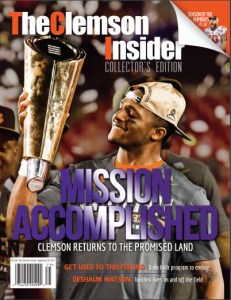
We are now taking orders for our limited edition magazine Mission Accomplished. Remember Clemson’s championship season with this great magazine from the staff that covers Clemson football 365 days a year. Order yours today to make sure you get a copy!