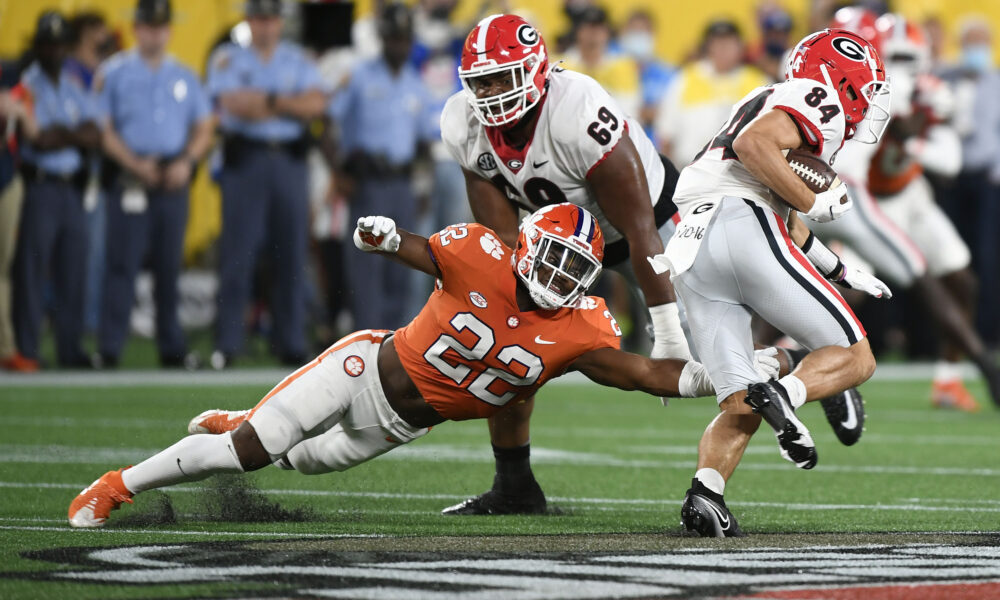
From 1977-’87, there was no better rivalry in college football than the Clemson-Georgia series.
Clemson won five, Georgia won five and there was one tie. They each won a national championship during the same stretch. The Bulldogs won it all in 1980 and the Tigers climbed the mountain in 1981.
The games were epic. Clemson held off a Georgia two-point conversion for a 7-6 road victory in 1977. The Bulldogs handed the Tigers their only loss in 1978. In 1983, both teams missed fields on back-to-back plays at the end of the game in a 16-16 tie.
In 1984, Georgia’s Kevin Butler made a 60-yard field goal in the closing seconds to beat then second-ranked Clemson. Two years later, Clemson’s David Treadwell returned the favor with a 46-yard game-winning kick as time expired. He hit a 21-yard field goal with two seconds to go to beat the Bulldogs at Death Valley in 1987.
It is not just the great games and history that make Georgia and Clemson such great rivals. The two campuses are 73-miles apart. They often are battling for the same recruits.
Clemson’s three national championship quarterbacks all came from Georgia. Homer Jordan, who led the Tigers to the 1981 National Championship, is from Athens. Clarence Kay, who played tight end at Georgia from 1980-’83, is from Seneca, S.C. — eight miles down the road from Clemson.
What’s my point in all of this?
What if Clemson and Georgia became conference rivals? Imagine the direction this rivalry might take.
Then think about this, imagine seeing Clemson play in Tuscaloosa or on the Plains in Auburn. How about a trip to Oxford or Knoxville? What about Gainesville? How cool would it be to make a trip to the Swamp? Then there is Norman and Austin, and let’s not forget about Baton Rouge, either.
These are the great venues and traditions that make college football so beloved. These are the things Clemson will get to experience should the Tigers receive an invitation from the SEC.
I am not saying that is going to happen. This is pure speculation at this point.
On Tuesday, I gave a glimpse of what life might look like in the Big Ten and tonight I’ll try to paint the picture of what it would look like in the SEC.
First of all, the money.
Starting 2024, SEC teams are expected to make somewhere close to $70 million each with the new ESPN/ABC deal they signed in 2022. Of course, if the SEC invites Clemson, Florida State or Miami, the potential to make more money and re-negotiate a new contract becomes real.
Granted there is a pitfall, too. It’s not like ESPN/ABC is growing money on trees. Last month, ESPN conducted massive layoffs, again, but this time it laid off some of its more visible on-air talent.
The question is, does ESPN have the money to take on a new deal with the SEC and since it likely does not, how does this affect the league in extending an invitation to schools like Clemson or Florida State?
Currently, Clemson and Florida State are still members of the ACC, but how much longer will they be there? Though the league set a record in revenue this past year, the $40 million it distributed to its 14 full-time member institutions is still way behind what the Big 10 and the SEC will start hauling in after 2024.
It is not the present Clemson and Florida State are worried about, it’s the future, and right now the grass looks greener in the SEC.
The money is not the only thing that makes the SEC appealing to Clemson. It’s all of it.
The passionate fanbases, the historic venues and traditions, traveling is much easier, the recruiting base and of course all the natural rivalries.
Outside of the ACC, Clemson has played no one conference more. In all, the Tigers have recorded 321 games against SEC teams.
Clemson has played Auburn 51 times, Georgia 65 and South Carolina 119.
The SEC is a natural fit. However, does the SEC think so?
Dear Old Clemson has just added Limited Edition signed Cade Klubnik replica road signs to the online store. Get your highway 2 sign today while supplies last!