CLEMSON — More than likely, most of us have not fully realized the ramifications of Tuesday’s news coming out of Clemson.
In case you were under a rock or something Tuesday morning, Clemson University filed a civil action lawsuit against the Atlantic Coast Conference.
According to the suit, “Accordingly, Clemson seeks a declaration from this court that: (i) the media rights Clemson granted to the ACC do not include any Clemson games that are played after Clemson ceases to be a member of the ACC; (ii) Clemson is not required to pay the ACC the withdrawal penalty, as such a payment is an unenforceable penalty in violation of public policy; and (iii) Clemson owes no fiduciary duties to the ACC or its other members and has breached no legal duty or obligation it might owe to the ACC by filing this lawsuit.”
What does it all mean? It means Clemson is not playing around anymore.
Clemson is telling anyone who will listen, like Florida State did back on December 21 of last year, it wants to continue to be a major player in collegiate athletics and it is going to do what is in the best interest of Clemson.
With the NIL, the transfer portal, the College Football Playoff and realignment, college athletics is changing like never before.
However, Tuesday’s lawsuit against the ACC is bigger than all of that, it’s about Clemson positioning itself to land in a Power 2 Conference.
The SEC and the Big Ten are controlling college athletics these days, especially college football. Clemson knows how important it is to have a seat at the table when the time comes that those two conferences pull away and do their own thing. And, as the new CFP contract has proven, the ACC is not and never will have a seat at the table again.
Clemson lays out in its civil case against the ACC, that it wants to have the power to negotiate with other conferences should it want to leave the ACC.
“In this litigation, Clemson seeks confirmation of the plain language found in the Grant of Rights agreements and the related media agreements between the ACC and ESPN – that these agreements, when read together, plainly state that Clemson controls its media rights for games played if it is no longer a member of the ACC,” the university said in a statement released to the media. “Clemson also seeks a ruling regarding the unenforceability of the severe penalty the ACC is seeking to impose upon exiting members and confirmation that it does not owe a fiduciary duty to the conference as alleged by the ACC.
“The ACC’s position regarding the Grant of Rights, the exit penalty, and obligations owed by members to the conference, as detailed in its public statements and other court filings, leaves Clemson with no choice but to move forward with this lawsuit.”
The university also said it has not given notice that it is exiting the ACC and remains a member of the conference.
This is not the first time Clemson has positioned itself to succeed in the Big-Boy World of College Athletics.
In 1931, Jess Neely spearheaded the charge to form IPTAY in 1934, using the first booster club organization in the United States to make Clemson Football a National Power through the 1940s and ’50s.
In 1951, when the Southern Conference told its member schools they could not participate in bowl games, Clemson’s Frank Howard and Maryland’s Jim Tatum stood up to the league and accepted bids to the Gator Bowl and Orange Bowl following the football season. When the league slapped them with probation and told them they could not compete against Southern Conference teams in 1952, Maryland and Clemson started laying the groundwork for forming a new conference.
That conference became the ACC and officially opened its doors for business prior to the 1953 football season.
It’s been 92 years since Neely, Captain Frank Jervey and others met in a car outside the stadium in Florence, S.C., following a 6-0 loss to The Citadel. On that day, Clemson made a conscious decision they were going to be a football power and do everything they could to get Clemson back on track.
In 1934, IPTAY began and by the end of the 1938 season, the Tigers were a power in the Southern Conference. In 1939, Clemson went 8-1 and was invited to its first bowl game. The rest is history.
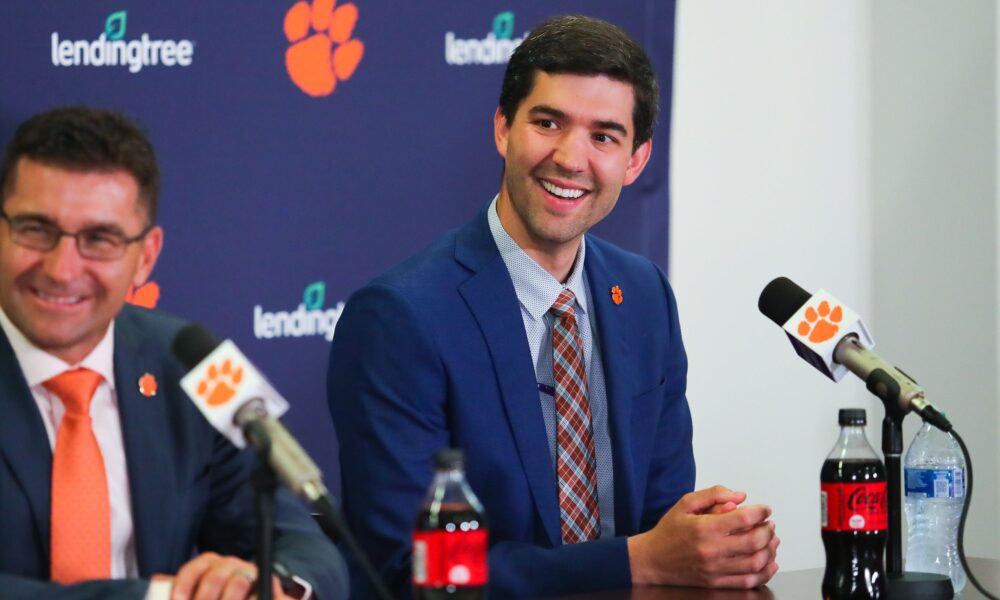
So, like Neely, Captain Jervey and Howard, current Clemson Athletic Director Graham Neff and President Jim Clements will go down in Clemson History as men who maintained Clemson’s place in major college football and athletics.
A limited number of signed footballs from Clemson’s 2022 class are still available. Get yours while supplies last! Visit Clemson Variety & Frame or purchase online!
