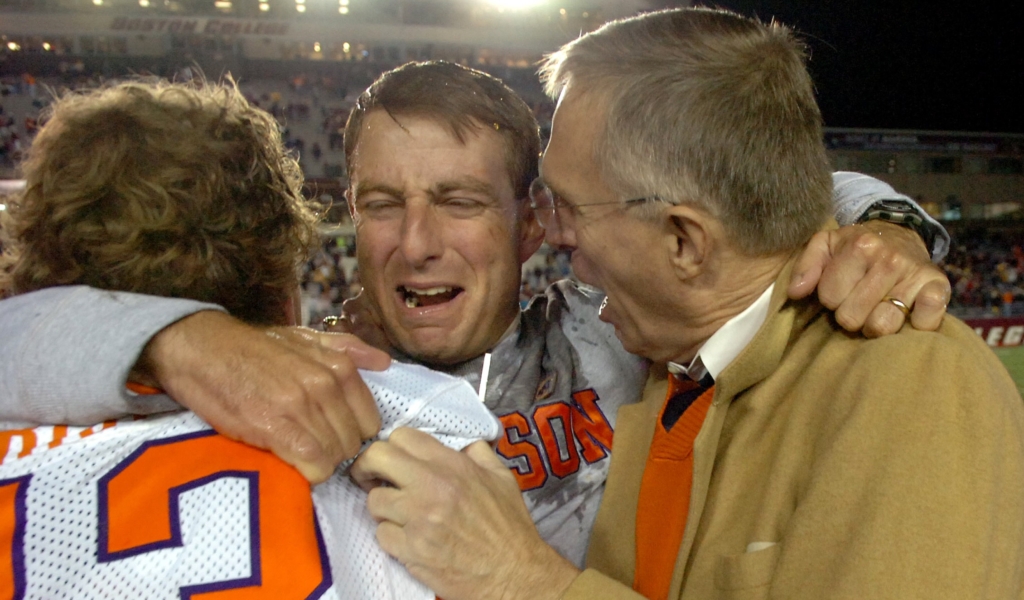
CLEMSON — It was just like any other summer practice in the month of August.
It was hot. It was humid. For Terry Don Phillips it was life as usual.
For more years than he can count, Phillips, a former football coach, spent his afternoons in August watching football practice.
“It is just something I have always enjoyed doing,” Phillips said.
Phillips, who passed away earlier this week at the age of 78, liked to go out and observe. He liked to watch the different styles of coaching, see how a coach tries to teach his players the game he grew up playing and coaching for so many years.
Though he was the athletic director at Clemson University, Phillips was a football coach first and his passion for teaching young people the game he loves so much never changed, even when he got into the administrative side of things.
“I just like to go out there and watch. I liked to see how coaches teach. I liked to see how they motivate their players. I enjoyed seeing the players develop and progress through coaching.”
However, on a particular August afternoon in 2003, Phillips came across a young coach that he suddenly became fascinated by. It was not abnormal to see a coach fussing at his players. That usually comes with the territory.
But this time it was different.
“I usually will go and watch the defense,” Phillips said. “I like to watch how they are coaching and how they are doing things. I generally will stay over there. I would look at the offense, but I generally would stay on the defensive side.”
On this particular day, Phillips found himself intrigued by Clemson’s new wide receivers coach.
“All I heard was this loud and intense voice on that side of the field. He was getting after them. But he was not yelling at them. He was coaching them. He was coaching them intently. I could tell that he was passionate about what he was teaching them.
“I wanted to see more.”
More and more through the course of camp, Phillips saw Dabo Swinney coaching up his players.
“It was not so much that he was coaching them as much as he was teaching them,” Phillips added. “He fussed at them and he got on them pretty good, but it’s the way he did it that was so intriguing. As soon as practice was over, he was loving on them and making sure they understood how much he cared about them.
“He does that better than anyone I have ever seen.”
Four the next five years, Phillips kept his eye on the young coach from Pelham, Alabama. He noticed in the football offices how the players all seem to migrate to him, and not just his position players, but even defensive players.
Swinney recruited a lot of the players that played for Tommy Bowden in those days, but not all of them. Yet, every time Phillips walked across the breezeway from the Jervey Athletic Center to the McFadden Building, he always noticed how Swinney had players in his office.
“He had such a great relationship with those kids, they would run through a brick wall for him,” Phillips said. “When I would walk through McFadden, he would always have kids in his office, and they were not necessarily his position players. The kids migrated to him. That in and of itself is an extremely important barometer with regard with that relationship you have with student athletes.”
Though he did not know of Swinney’s desire to be a head coach, Phillips saw a potential head coach in Dabo Swinney, and if the opportunity ever presented itself, he would give him a chance.
However, that opportunity almost did not happen.
Following the 2006 season, Swinney came into Phillips office and asked for a favor.
“Of course, Dabo wanted to be a head coach,” Phillips said. “It wasn’t that he wanted to leave the program or anything, but he was like every other young coach. He wanted to be a head coach. If he had an opportunity to go somewhere and prove himself, he would have liked to have done that.”
Swinney handed Phillips his résumé and asked if he might put in a good word. He had applied to be the head coach at South Alabama, which was just starting its program.
“I would not have taken the job if it was offered,” Swinney said, “but I needed to go through the process. I needed to know what it was like. I put a lot of time and energy into it. I pursued it as if it was my dream job.”
However, South Alabama was not the only job Swinney applied for. There was another. The UAB job opened up and in Phillips’ mind Swinney seemed like a perfect fit.
“Dabo gave me his résumé and everything and I tried my best to talk to them about Dabo, but I could not get to first base with them, which we were very fortunate that occurred,” Phillips said.
But Clemson was not out of the woods just yet. At the same time, Alabama started courting Swinney to be its new passing-game coordinator.
The Crimson Tide was set to hire Rich Rodriguez to be its new head coach. Swinney was actually going to go and the night before Rodriguez was to tell his West Virginia team he was leaving to take the job at Alabama, the story was leaked to ESPN.
“Once it got leaked out, he got nervous and backed out,” Swinney said. “The only reason I know this is because Mal Moore was keeping me in the loop. Rich Rod decided to stay at West Virginia and Mal was back to square one.”
Moore then proceeded to go after Nick Saban, again. Saban, who was the Miami Dolphins head coach at the time, had already said no to Moore, but this time the Alabama athletic director did not take no for an answer. He convinced Saban to leave Miami for ‘Bama.
Clemson running backs coach at the time, Burton Burns, left Clemson to join Saban’s staff and he tried to convince Swinney to join him in Tuscaloosa. Saban offered Swinney a lucrative deal to be his passing-game coordinator.
“It was a lot of money, but it was bad timing,” Swinney said. “It just did not feel right. My spirit was not feeling good about it.”
One reason was because Swinney was loyal to Bowden. The former Clemson head coach took a chance on him after Swinney had been out of coaching for two years, when others would not. That meant something to Swinney.
“Tommy Bowden deserves a lot of credit. He had the guts to hire me. I had been out of coaching for two years and I had a lot of doors closed on me. But Coach Bowden believed in me and he gave me an opportunity.”
Swinney was also loyal to the recruits he was about to sign and his players.
“It was bad timing. I had six guys committed and I did not want to do that to them. Coach Bowden had been good to me, and I did not want to leave him hanging. At the time, I did not know Nick. I knew nothing about him.
“It just did not feel right. I did not have a good spirit about it.”
However, Swinney did use the Alabama courtship as some leverage. At the time he, like a lot of the coaches on the Clemson staff, was on a one-year contract. However, Swinney wanted a two-year deal for a little more job security.
“I met with Terry Don, and he did not blink an eye, so I stayed on.”
Clemson dodged a bullet, and at the time they had no idea how big the bullet was.
Bowden step aside on October 13, 2008 and gave Swinney an opportunity to show what he can do. What he did was become the first interim coach to take over a team at mid-season and guide that team to a bowl game. He was the first interim coach in the history of college football to finish the year with a winning record.
Following a 31-14 victory over archrival South Carolina to close the regular season, Phillips hired Swinney as the next head coach.
“If I had not had the opportunity to be the interim, I’m probably not here,” Swinney said.
Phillips gave Swinney complete autonomy. For seven weeks he could run the program the way he would run it if it was his own.
“This was an opportunity to see how he would do,” Phillips said.
“I walked out of his office walking on the clouds,” Swinney said. “I was empowered and energized because of his belief in me.”
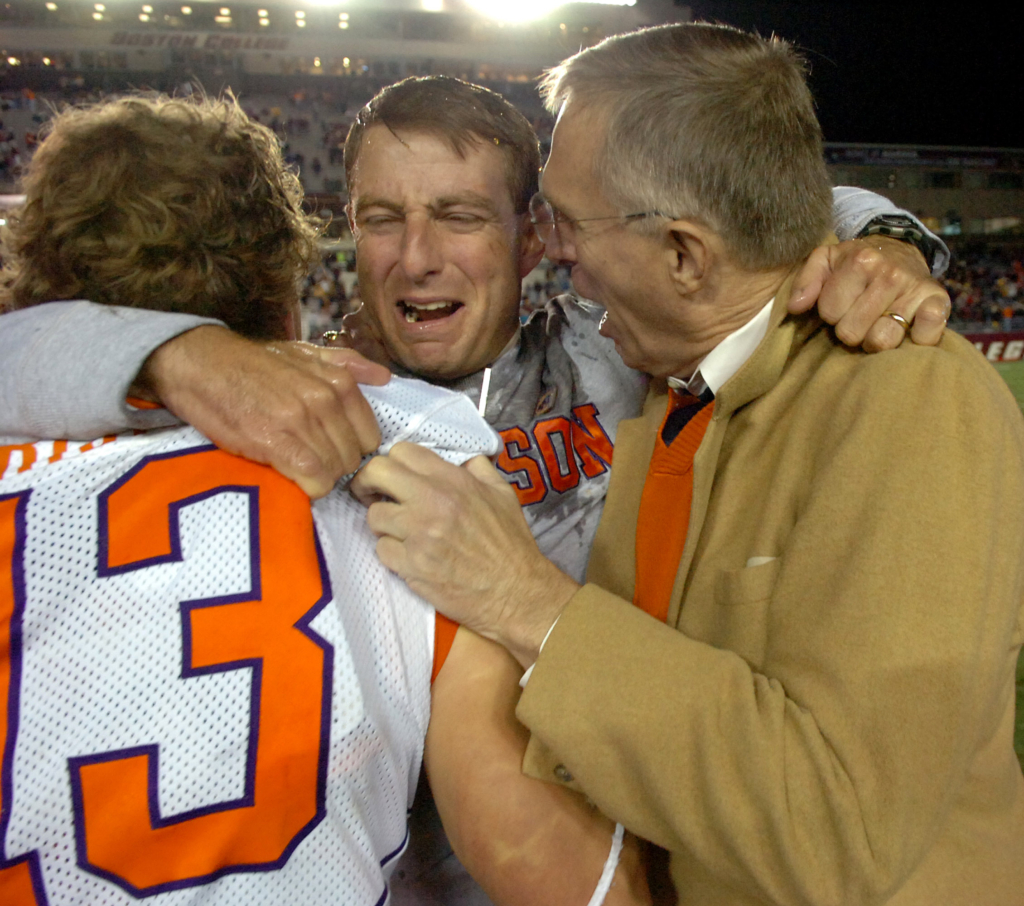
Swinney thrived, primarily due to the five-minute conversation he had with Phillips. Clemson proceeded to beat Boston College, Duke, Virginia and South Carolina to close the regular season with four wins in its final five games. A lot of people were surprised by the Tigers’ strong finish with an interim coach at the helm. Not Phillips.
“He was happy to see me get an opportunity, but we both knew I was going to have to win some games to have a chance,” Swinney said. “We were able to get it going. So, it kind of made it easy for him. He told me up front, ‘I would love to see you get this job. I think you are ready for this job. I think you would be a great fit. You are just going to have to find some way to win some games. I want you to be the head coach. I don’t want you to be the interim head coach. I want you to act like the head coach, think like the head coach and do whatever you need to do to fix this. Whatever it is, I’m going to support you and let’s go for the next seven weeks. You will get an interview no matter what.’
“The fact that we were able to win some games made it easier, but he took a huge chance. He knew he was going to be tied directly to that decision.”
Phillips did not care. He saw something in Swinney no one else did.
“Our program is not where it is without Terry Don,” Swinney said. “He went with his gut and with his instinct. He watched me for five and half years. He knew what I could do.
“There are very few athletic directors out there that would have given me that opportunity.”
On December 1, 2008, the interim tag was removed from Swinney’s title. He was now the head coach of the Clemson Tigers.
“Terry Don told me when he hired me, ‘You just continue to be who you are. Go with your gut and your instincts and I’m going to support you,’” Swinney said. “‘We are in this for the long haul. I believe in you. I think you are going to be one of the best coaches in the country. But there will be some good times and some bad times, but I just want you to know that I got your back.
“‘I don’t want you to be distracted by things that don’t matter. If it doesn’t work, I will help you pack, and you can help me pack and we will go together.’”
That nearly happened in 2010. Injuries and lack of depth derailed the Tigers. The season concluded with four losses in their last six games. But there was a sign of promise. Clemson lost five of its seven games by six points or less and another one was by just nine points.
The only game in which they did not have a chance to win was against the Gamecocks, who beat the Tigers, 29-7. It marked the first time South Carolina defeated Clemson in back-to-back years since the 1968-’70 era.
“That was a low point. Everybody felt awful,” Phillips said. “But when things are going great, everyone is doing great, but to really get a true evaluation of a person is to see how they handle things when things are not going well.”
Phillips said Swinney was never changed. In spite of everything that was going on outside of the football program’s office that year, what the media and those on social media were saying, his young coach never changed his approach. He stayed strong. He stayed consistent for his coaches and his staff.
As he walked through the hall on the second floor of the West Zone of Memorial Stadium following the loss to South Carolina, a dejected Swinney saw his wife coming down the hall to tell him that Phillips was in his office.
“I was like, ‘Well, it was a nice two-year run,’” Swinney said.
Swinney wasn’t sure what to expect when he walked into his office. The room was dark with the exception of one light and sitting on the couch in the shadows was Phillips.
“What was in my mind, my mind was totally opposite of what I got,” Swinney said.
Swinney knew Phillips had a lot of pressure on him as well.
“Terry Don looked at me and said, ‘Dabo let me tell you something. I know it’s a tough time and there is going to be some negativity, there is going to be some criticism and there is going to be this and that,’” Swinney recalled. “‘But here is what I want you to know. I’m more confident right now, at this moment that you are the guy for this job and that you will be successful than I was before I hired you. That’s all I have to say.’”
Phillips’ objective that night was to make sure Swinney knew he had his total support. He did not want his young head coach to think any of the things people were saying were true.
“I felt stronger about him than when I hired him,” Phillips said. “That was a tough year. People were all around our necks.
“The way he handled adversity. The way he handled his staff. How he handled the players and how he handled himself publicly, tells you more about the kind of person they are than when everything is going well. It is easy to do those things when everything is going good.”
It started to get easy for Phillips and Swinney in 2011. Thanks to talented players like Tajh Boyd, Dwayne Allen, Deandre Hopkins and a superstar freshman by the name of Sammy Watkins, Clemson rose to the top of the ACC for the first time in 20 years.
They also won 10 games in a season for the first time in 21 years.
“I knew he could get the job done,” Phillips said. “I did not want to have any regrets. I knew he was going to be great, and darn it, I did not want him to be great somewhere else.”
Swinney has become the greatest coach in Clemson history, and one of the best in the country.
The Tigers won their second national title in three years with its 44-16 win over Alabama in the 2019 College Football Playoff National Championship Game.
For more than three decades, Clemson fans longed for another 1981 season, another national championship and now Swinney has delivered two, including a 15-0 season … the first in the modern era of college football.
“We rolled the dice when we hired Dabo. He did not have the pedigree,” Phillips said. “But I just felt like Dabo had some special characteristics in regards to how he treated players, how he felt about players and you could see why he was successful in attracting good quality young people to come into the program. When you step back, you say, ‘I think this is worth the gamble.’
“I did not really feel like it was a gamble because I believed in due time that it would work out. Certainly, in those early years there were people all over me and they were not being very kind.”
It did work out for Phillips, and for Clemson, of course. Though he did a lot of great things in his 10 years as Clemson’s Athletic Director, the one move his legacy at Clemson will always be tied to was his belief in a young football coach that he knew was going to be special.
–Editor’s Note: This story is an excerpt from my book The Hidden History of Clemson Football