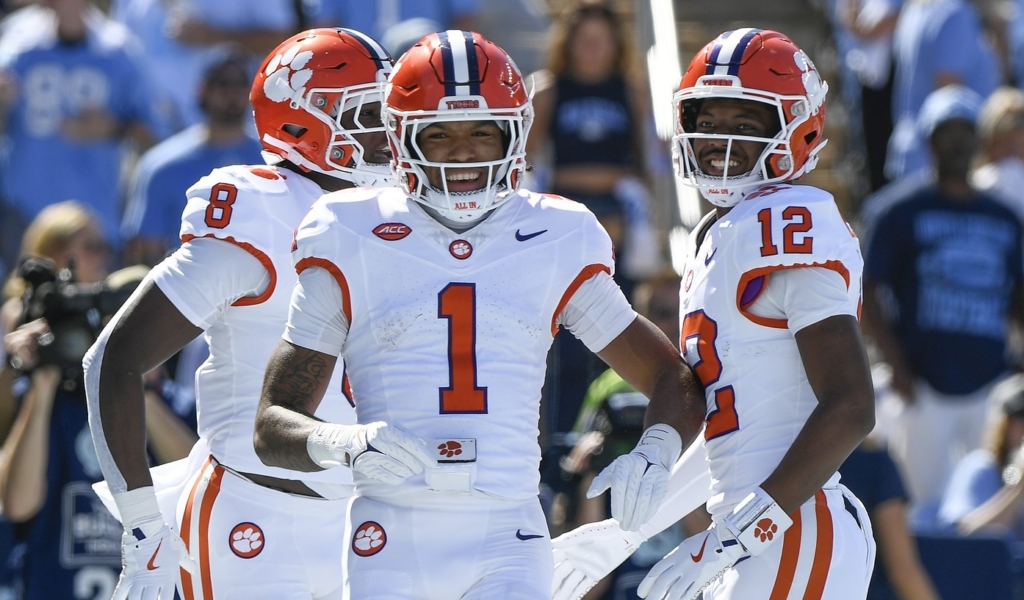
CLEMSON – Before every home football game at Memorial Stadium, Clemson’s starting lineup is announced, player by player, on the video board around an hour before kickoff.
As early-arriving fans see names and faces flash on the screen, they erupt with applause proportional to how well they know each athlete and how successful the players have been in a Tiger uniform.
In the Tigers’ home opener on Sept. 12, up to seven new faces will flash on the video board when Clemson introduces its offensive starters– players that will be thrust into the limelight for the first time this season.
When it comes to the starting wide receivers, however, Death Valley will undoubtedly recognize the LED-light-written names of Bryant Wesco Jr., T.J. Moore and Tyler Brown — three veteran wide receivers who have played major roles in the last several football seasons.
Their names will most certainly raise some of the loudest cheers.
In 2023, Tyler Brown made a name for himself in the college football landscape as a freshman, finishing with 531 yards on 52 receptions, leading all Tiger players after veteran Antonio Williams went down with an injury. He earned freshman All-American honors for his rookie campaign, catching a one-handed touchdown in a win over Georgia Tech to cement his breakout season.
The Greenville, S.C., native suffered an injury his sophomore year that sidelined him for much of the season, and with Williams back, it was Wesco and Moore’s time to shine.
As a freshman, Wesco finished third in the ACC in yards per reception, (17.27) scoring five touchdowns and notching 708 receiving yards in 12 games. Like Brown the year prior, Wesco also finished with freshman All-America honors.
T.J. Moore was not far beyond his fellow freshman receiver in 2024, finishing with five touchdowns on an average of 46.5 yards per game. His talents shone even more however in 2026, when he caught 52 passes for 837 yards. His 16.10 average yards per catch were sixth-best in the conference.
Wesco was on pace for an All-ACC campaign last year with six touchdowns in as many games until a scary neck injury cut his season short against SMU. Through six games, he led the ACC with 537 yards on 31 receptions before going down with his injury in the seventh game.
Wesco’s injury was not the only setback for the Tigers. Clemson led the nation in dropped passes and at times, against physical defenses, struggled to get off the line, which knocked off the timing of their routes and led to more pressure on quarterback Cade Klubnik.
Williams left Clemson for the NFL, where he was drafted by the Washington Commanders in the third round and at No. 71 overall. Wesco looked like an All-American until his injury, and Moore stepped up as a primary offensive weapon and answered the call.
However, transfer product Tristan Smith struggled with drops, while Cole Turner struggled against physical defenses at times and Brown never found the magic from 2023. Former receiver Adam Randall, who was moved to running back, emerged as Klubnik’s third option, as he finished third on the team behind Williams and Moore in receptions.
Now, with a new quarterback, offensive line and coordinator calling plays, the receivers will be the centerpiece of the 2026 team, a familiar beacon remaining from the last era of Clemson football. Moore and Wesco have the ability to be stars and have shown they are capable of such expectations. With Williams in the NFL, Brown has an opportunity to get back to where he was a few years ago and has the knowledge and confidence to know he can do it.
The courts came to bat for Smith and gave him another year of eligibility, and he has vowed to be better. Turner is coming off another offseason of injury issues so the verdict is still out. However, Clemson again brought in a solid group of freshman pass catchers, led by Gordon Sellars III and Naeem Burroughs, who both impressed the coaches at times in the spring. Fellow freshman Connor Salmin also took advantage of his opportunities with Moore, Wesco, Smith and Turner all limited in practice this spring.
Chad Morris, who took over the offense in January, knows how to get the ball to his playmakers. In his last stint at Clemson from 2011-14, Morris coached players like Sammy Watkins, DeAndre Hopkins, Adam Humphries, Artavis Scott and Mike Williams, names that Tiger fans would greet with booming applause after they set school records and continued onto professional careers. Hopkins (2013), Watkins (2014) and Williams (2017) were all first-round selections.
Morris also helped others such as Jaron Brown, Charone Peake and Martavis Bryant make it to the NFL, as well.
As the head coach at SMU, Morris developed wideout Courtland Sutton, a two-time Pro Bowler and as the head coach at Arkansas, he mentored Treylon Burks — another first-round draft pick.
These players each showcased immense talent. Some had elite speed. Others had elite hands or route-running skills. Others, like Watkins and Hopkins, had all three. Yes, Morris was working with top-end talent, but he also put them in a position to shine.
A staple of Morris’ offense, which debuted when the Tigers won their first ACC Championship under head coach Dabo Swinney in 2011, is its up-tempo style. With Hopkins and Watkins breaking all of Clemson’s receiving records, the Tigers finished with nearly 4,000 passing yards, up nearly 40 percent from the season before while attempting 116 more passes.
Under Morris, the Tigers continued to find offensive excellence over the next three seasons, enough to usher on a decade of success that boasted two national championships, six College Football Playoff appearances and six more ACC Championships.
But why, specifically, does a “Chad Morris” offense benefit receivers?
Above all, the answer is simple. Morris knows how to get the ball to his playmakers.
The first way he accomplishes this is through the up-tempo style he has become known for. With quick snaps, opposing defenses have no time to communicate. This creates mismatches, and leaves receivers like Wesco, who has elite speed, with a chance to capitalize on one-on-one coverage.
For players like Moore, who has already shown fluidity after the catch, this helps provide opportunities to make more plays after the catch. Additionally, Morris trusts his playmaking receivers with option routes, allowing them to isolate against a defender and make a move to get open.
For tall wideouts like Smith (6-foot-5), Moore (6-3) or Sellars (6-foot-3), Clemson’s new offensive coordinator will give them opportunities to go up and highpoint the football downfield, which is what he did with Hopkins, Watkins, Bryant and Williams with regularity. For Wesco, Burroughs, Salmin and Juju Preston they will get the ball quickly, with jet orbits, pop passes and quick slants, allowing them to use their speed and wiggle to their advantage.
Morris’ focus on the run game also creates opportunities in the passing game. With defenses worried about stopping the run, slot receivers like Brown are able to sneak through the middle and get behind linebackers and safeties that come up to stop the run.
While there are questions about Morris’ offense translating to 2026, as defenses have adjusted to schemes that seemed like witchcraft a decade ago, one thing is probably still true. Morris’ offense is designed to get the football deep down the field.
It is also true that this could be the deepest and healthiest the Tigers have been at wide receiver in several years. With that, it makes sense that several of Clemson’s wideouts could have breakout seasons, and in turn give fans a reason to scream when they hear starting lineups announced.