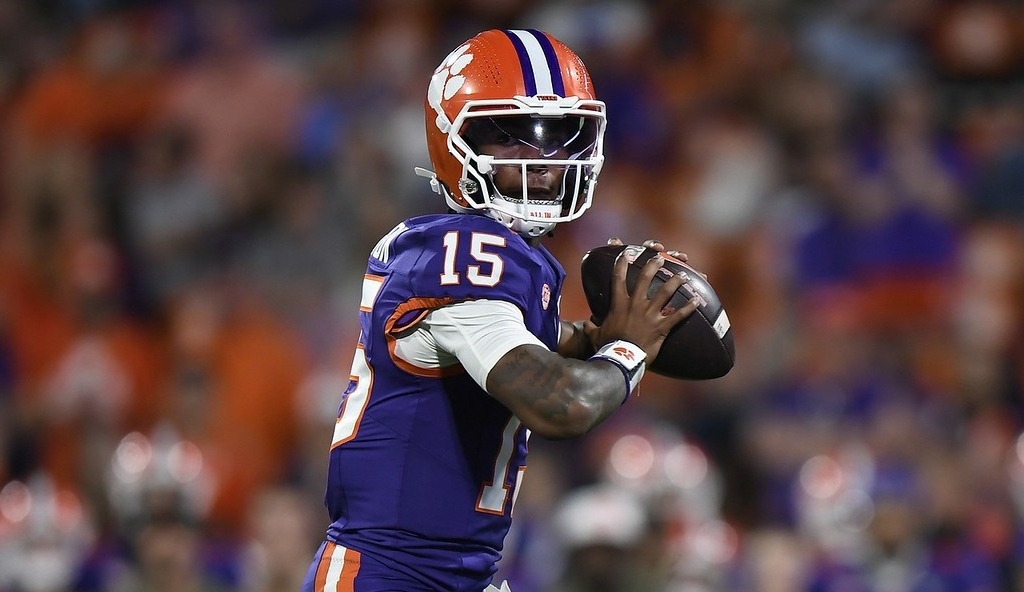
CLEMSON – Former Clemson head coach Tommy Bowden’s recruiting pitch to Chansi Stuckey, a 5-foot-11 quarterback from Warner Robins, Ga., was simple.
“You can be the next Woody Dantzler,” Bowden told the quick-footed signal-caller in the late months of 2001.
The comparisons made sense, and the evidence was fresh on Stuckey’s 17-year-old mind. Just a few months prior, Dantzler had become the first-ever college quarterback to finish with over 2,000 passing yards and 1,000 rushing yards in a season, pioneering the “dual-threat” moniker that so many signal-callers hold today.
Dantzler also led Clemson to a 9-3 season in 2000, a crown jewel of Bowden’s 10-year tenure with the Tigers. He missed the 2,000, 1,000 mark that season by just a few passing yards, helping to cement him in both the Clemson and South Carolina Halls of Fame.
Like Dantzler, Stuckey was fast, especially with the ball in his hands in the open field. He had a solid arm, but at 185-pounds, his best work came when he had room to create in space.
So, with Bowden’s pitch and with Dantzler’s success ruminating across the southeast, Stuckey committed to Clemson and enrolled in 2002, eyes wideopen to the possibility of continuing a line of athletic Tiger quarterbacks.
Quickly, though, he found himself below Charlie Whitehurst, a prolific pocket passer and eventual Clemson legend, on the depth chart.
Stuckey had a few options.
He could transfer and sit out for one year at another program before getting an opportunity to play.
He could wait out Whitehurst’s three remaining years and hope to earn the starting job in 2006, his senior year.
Or, in a completely different move, he could listen to the newly-hired, loud-talking wide receivers coach who was just out of a commercial real estate job — a staffer Stuckey and his teammates initially thought would be “roadkill.”
That new wide receivers coach, Dabo Swinney, wanted Stuckey to become a wide receiver.
At the time, and as Stuckey knew well, similar position switches were far from unheard of. Hines Ward had recently completed a career at Georgia in which he played running back, quarterback and wide receiver. He went on to play 14 NFL seasons with the Pittsburgh Steelers and finished second in Georgia’s all-purpose yards category.
Antwaan Randle El, a star quarterback at Indiana during the turn of the century, transitioned to receiver at the pro ranks and carved out a long career as a receiver, but coincidentally, Randle threw a touchdown pass to Ward in Super Bowl XL, while playing wide receiver.
Similarly, Kordell Stewart of Colorado played running back and receiver for the Steelers before taking the starting job and making the Pro-Bowl in 2001 at quarterback.
Still, Stuckey was hesitant.
“In that moment, I had a couple choices I could make,” he wrote in a 2017 article. “I could sit behind (Whitehurst) for three years. I could transfer to another school and sit out a year. Or I could make the switch and begin playing ball. I trusted Dabo. I had seen his body of work. Looking back, after a five-year NFL career, it was an obvious decision. At the time, as an immature and stubborn 19-year-old, it was a lot tougher.”
As Stuckey alluded, the change was eventually a smashing success. Under Swinney’s “grueling” leadership, he went on to play three seasons at receiver for Clemson, amassing 1,750 receiving yards and nine touchdowns.
The former QB was selected in the seventh round of the 2007 NFL Draft as a wide receiver by the New York Jets and played four full seasons, catching five touchdowns on 1,062 yards. Meanwhile, during Stuckey’s rookie NFL season, Swinney was promoted to interim, then permanent head coach at Clemson.
“I guess you could call Dabo Swinney a visionary,” Stuckey wrote. “Forward thinkers can see people for what they are before we even see it ourselves. That’s what happened with Dabo and me. In a sense, I owe my NFL career to him. And having known the man since he was just an anonymous position coach, since before Clemson became a national powerhouse and then national champions, I can’t say that I’m surprised by any of it.”
Over 20 years after Swinney-prompted position change, Stuckey is now the wide receivers coach at Marshall University, after coaching stints at his alma mater and at Notre Dame from 2022-23. Swinney, on the other hand, led the Tigers to two national championships in 2016 and 2018, and is entering his 18th season at Clemson’s helm.
And though the leader is no longer just the wide receivers coach who “gets after people,” he might have entered a Stuckey-esque situation ahead of the 2026 season.
In 2025, Clemson welcomed Chris Denson, a true freshman quarterback and Plant City, Fla., native onto the roster. Denson was listed as a three-star prospect and, like Stuckey, showed immediate speed, though he has a slightly bigger 6-foot-2 frame.
Denson saw limited action in 2025, buried a few quarterbacks behind starter Cade Klubnik, but completed 4-of-4 passes and rushed for 108 yards on seven carries in his 11 offensive snaps in a blowout win over Furman.
In a twist at the end of spring practice, Swinney announced that Denson was no longer in the race to be the Tigers’ 2026 quarterback, falling behind on the depth chart to redshirt junior Christopher Vizzina and freshman Tait Reynolds.
“Denson is physically as gifted as anybody we got, but just not where he needs to be from a passing game standpoint to compete like he needs to,” Swinney said back in March. “So, if he stays at quarterback, because I think he’s a guy that’s got a decision to make, he will play for us. He’ll have a role. He’s too talented. We definitely have a role for him.”
A few months later, towards the end of summer workouts, offensive coordinator Chad Morris laid out what that role might mean for Denson.
“He’s been all over the field,” Morris said. “He’s played some wide receiver. He’s been some in the backfield. He’s just kind of been all over and still working, in there at the quarterback position. I mean, it’s just kind of moving him around, trying to find a place to get him the ball.
“He’s electric with the ball in his hands and so part of it is trying to find a way to get the ball in his hands.”
From Morris’ assessment, it looks like Denson could be working towards becoming an all-purpose player like Ward or Stewart, more than a Stuckey-type permanent wide receiver. Still, if there is any coach that understands what that kind of transition takes, it is Dabo Swinney, one of the longest-tenured coaches in college football.
Denson, as well as the rest of the Tigers, will have two weeks of intense coaching and tinkering in fall camp, starting Aug. 6, ahead of their season opener against LSU on Sept. 5.
Clemson fans can expect to see Denson– whether against LSU or in another game– in some capacity this season, even if it is not at quarterback. And with an example like Stuckey, success is possible for Clemson converts.