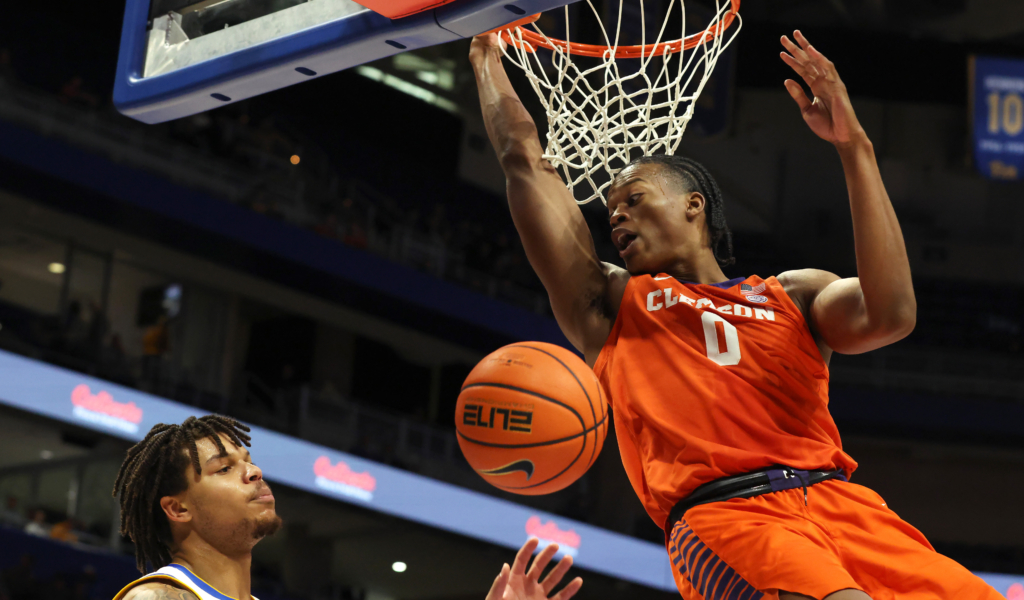
CLEMSON – On Friday, Judge Charlotte Sweeney of the U.S. District Court of Colorado granted a class-wide preliminary injunction to athletes in the high school class of 2022, thus giving them an extra year of eligibility.
In light of the NCAA’s move to the “five-in-five” model, which will allow athletes five total years to play at the collegiate level, this injunction will grandfather the 2022 class into the system, which originally was not the case.
While this development will allow the group of athletes who just wrapped up their fourth season of eligibility an extra year, it also provides some major questions.
Namely, how will this work with upcoming rosters already finalized? The injunction takes away limited roster sizes, giving eligible athletes an opportunity to either return to their old school or enter the transfer portal and go elsewhere. The transfer portal is expected to open Aug. 3-10 for athletes that are impacted by the ruling.
For Clemson’s basketball programs, two men’s players and four women’s players could be affected by this decision.
On the men’s side, veterans R.J. Godfrey and Dillon Hunter will now be granted an additional year of eligibility. Last season, Godfrey–a 6-foot-8 forward–led the Tigers with 12 points and 5.3 rebounds per game en route to his third NCAA Tournament appearance as a senior.
The Suwanee, Ga., native also played a large role in Clemson’s Elite Eight run back in 2024, before transferring to Georgia for a season and coming back to play for head coach Brad Brownell last summer.
In June, the veteran spoke with The Clemson Insider about his feelings about a potential return, and, at the time, the low probability of coming back for a fifth season due to eligibility restrictions.
“There was about two weeks there where I was praying like, ‘Man, I want one more shot for the Tiger family,” Godfrey said. “These guys, this fan base, deserves a national championship. And when I heard that we could probably get retrograded in and grandfathered in, man, I was so excited.”
“But, but hear them say now, you know, we probably won’t get grandfathered in, it made me sad for a couple hours,” he added before talking about a potential professional career.
Similarly, guard Dillon Hunter just finished his fourth season with the Tigers, making 35 starts and leading the Tigers on both offense and defense. He shot 34 percent from three-point range last season and averaged 7.5 points per game.
While Godfrey has remained silent on social media platforms since the decision, Hunter posted a video of Godfrey dancing with the caption “mood,” as well as a thinking emoticon, pointing to a potential decision to make.
Hunter’s issue, however, is that he signed a contract with Eisbären Bremerhaven, a German professional team, just two weeks before the ruling was announced. However, Hunter could return to college basketball for one more season should he want to. Since was was not drafted by the NBA he is allowed to return according to the TRO.
Hunter and Godfrey’s situation, as well as many others across the country, point to an uncomfortable problem. Sure, coaches may want their best, senior players to return for another season. However, with Name, Image and Likeness funding, most rosters and contracts have already been finalized in men’s basketball.
Clemson, for example, went into the transfer portal and got three big men, two power forwards and a center, partially to help with the absence of Godfrey inside. These players, of course, did not commit to the Tigers for free.
Take it from Samford’s head coach Lennie Acuff, who coached new Clemson forward Dylan Faulkner last year.
“He didn’t want to leave but the amount of money he can make, I told him, ‘Dylan you can’t come back,” Acuff said in April. “He’s going to go and make a lot, a lot, a lot, a lot of money.”
So if Clemson is giving Faulkner, who was a Southern Conference first-team member last year, a “lot” of money (with three ‘extra lots’) is there any financial room to pay Godfrey or Hunter for a fifth season?
Had head coach Brad Brownell known of this two or three months ago, the Tigers’ 2026-27 roster could look entirely different right now.
Similarly, women’s head coach Shawn Poppie is now looking at a potentially different roster as well. A source with knowledge of the situation, told TCI on Saturday that the coaching staff is working through what this actually means, as it has obviously changed quite a bit.
When Poppie recently met with the Clemson media in July, he explained that two players–guard Mia Moore and forward Taylor Johnson-Matthews–were fighting in court to play one more season at Clemson.
Both players had sued the NCAA for one more year of eligibility and had been denied, despite other athletes across the country being granted one more year in similar circumstances, including Clemson football’s Tristan Smith.
Moore, a 2021 high school graduate, may still remain unaffected by the new verdict, though she can continue to keep fighting it in court.
Johnson-Matthews, on the other hand, graduated in 2022, thus making her eligible for next season.
“Taylor is an unbelievable kid and played a huge part in our team last year,” Poppie said. “Whatever it is, and this is no different than her and Mia, my biggest thing is just to make sure that whatever happens that they’re taken care of when decisions are made.”
Last season, the Cleveland, Ohio native, finished in double-digit scoring figures 17 times, and had a trio of 20-plus scoring performances. She averaged 9.5 points for the Tigers in Poppie’s second year and shot 39 percent from deep range.
With her return, Clemson would regain experience, shooting and athleticism. In the meantime, she and Moore have both stayed local, practicing with the team and training alone.
Raven Thompson, another key piece of last year’s team, is now also eligible to return to college basketball. Thompson started in 31 games last season, averaging 7.5 points and 4.5 rebounds. According to a source close to the team, she has remained in Clemson, though she has not been practicing with the team, unlike Moore and Johnson-Matthews.
Two other post players, Hadley Periman and Morgan Lee, will also be granted a fifth year if they choose to take it.
In the coming days and weeks, Poppie, Brownell and fifth-year Clemson players will have some decisions to make with the rest of the country as the landmark legal decision takes shape ahead of the academic year.