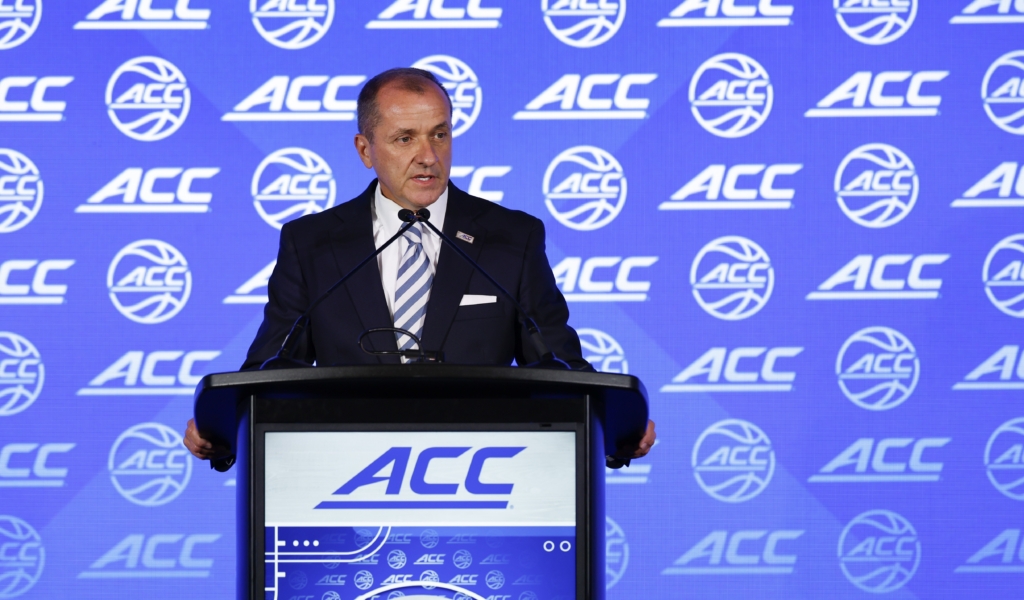
Atlantic Coast Conference Commissioner Jim Phillips told those who were covering the ACC Basketball Tipoff event on Tuesday at the Hilton Charlotte Uptown in Charlotte, N.C., that he supports all 18 of the league’s member institutions as they engage directly with Congress when it comes to the Protect College Sports Act, even those four schools who want the realignment portion of the bill amended.
Those four schools are Clemson, Florida State, Miami and North Carolina, which Tomahawk Nation’s Jon Loesche first reported late last week and The Clemson Insider confirmed.
The four ACC schools’ leadership all signed a letter which was sent to the House of Representatives in Washington, D.C., asking their representatives to change section 205 of the bill.
“Listen, my directive is I serve the membership, so I try to push what the membership wants,” Phillips said. “We have 14 schools that feel really good about it that want to sign it, and we have four schools that have an issue with a portion of it, so that’s what I’m going to continue to push towards the decision makers and those that have written the bill to date.”
According to Tomahawk Nation, “There is, however, one provision that we believe warrants adjustment—Section 205 as it pertains to institutional movement between conferences.”
“The three-year independence requirement would impose a significant additional consequence on an institution seeking to change conferences, particularly when conferences and their members have already negotiated the financial terms surrounding an exit.”
The schools are clearly working as a group, as noted by the statement: “As the legislation moves to the House, our coalition has worked together to identify a compromise that addresses our concerns…”
What are the four schools asking for?
“Increase the conference membership cap from 20 to 22 institutions” and “Remove the independence requirement for an institution departing one covered conference before joining another.”
In his Commissioner’s Forum on Tuesday, Phillips said federal legislation is an industry-wide effort and there are thee to four things he could probably say about the letter his four ACC schools sent to the House.
“You have the individuals, the elected officials, that put this thing together. You certainly get input from various groups, whether they be donors, whether they be the president’s commission on college sports, whether they be conferences, athletic directors, coaches, student-athletes,” Phillips said. “So, they come together to try to create the best bill that they can. That’s one.
“Two, is that it’s rare to have unanimity on anything as it relates to a bill in particular. The 171-page document, there’s an awful lot that people like and don’t like, so you have that piece of it and the significance of the bill. I’ve said from the very beginning, and will continue to do so, my job is to state and support all 18 schools. We don’t have unanimity in our league, and you just pointed that out with four schools. So, making sure that the Senators know and making sure that those schools, whether you’re for the Protect College Sports Act or you’re against a portion of it — I don’t think they’re against all of it — but a portion of it, they need direct access to state their case.”
Lastly, Phillips says his goal is to do everything in his power to make sure the ACC is a league everyone wants to be a part of.
“I’ve been very consistent about I have always tried to make sure that this was a conference that people wanted to be in, and I’m really proud of what we’ve done. We’re as healthy as we’ve ever been,” he said. “I said it in July because I mean that. If you look at the metrics of revenue generation and what we’re going to give out to the membership next year, it will border $1 billion for the first time. It’s up 57 percent.
“Competitive success? Thirty-six national championships in the last four-plus years. Academic success? No. 1 ranked FBS conference in the country for 19 straight years. And then innovation, all of those things. I can go down that list. I’m not going to bore you with all that. We’ll continue to stay in contact with all the schools. My job is, again, to facilitate those conversations, and at the end of the day, the people that have written the bill and are in charge of the bill. They can do what they think they should based on the information that they’re getting.”
As for the PCSA’s Section 205 being amended and possibly opening the door for a mass exodus of ACC schools, Phillips cannot concern himself with hypotheticals at this moment.
“I don’t want to get into hypotheticals,” he said. “I stand by what I’ve said. The conference is in a good place. Healthy, functioning, achieving at a high level.
“We’ll see where all this takes us. So, you have to be ready. You have to be ready for anything, but I feel good about where we’re at, and we’ll see what this bill ends up doing.”
The PCSA was passed by the U.S. Senate late last month by a 77-23 vote. It has since moved on to the House for approval.
“But there’s been a lot of work across the country on this thing. We’ll see kind of where it goes. It passed the Senate 77-23, which in this day and age is — I think it’s a pretty strong statement,” Phillips said. “But it now has to go through the House, and there’s a recess right now, and there’s going to be an election in early November. I’m not sure what that will mean, but that’s kind of where we sit today in early October.”