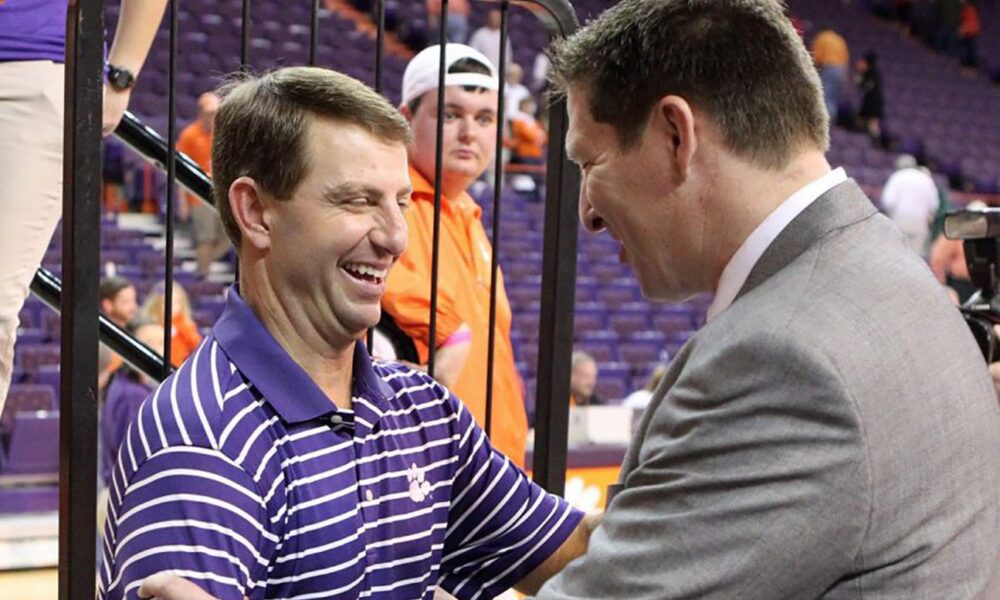
Clemson athletic director Dan Radakovich says too much freedom is not a good thing for a college student when it comes to transferring to another school.
Next month, a proposed rule change will go to vote to the NCAA that will allow student athletes in football and basketball to transfer and immediately play the following season at their new school as long as they meet specific academic requirements.
Currently, undergraduate student athletes are required to sit out a year after transferring to another school.
“I’m not sure it is a good thing to have that kind of freedom,” Radakovich said earlier this week to The Clemson Insider at the ACC Spring Meetings. “Not that freedom is bad. Freedom is good, but when you are looking at a college student is it good for them to be able to come in with all the time they need to put in from an athletic standpoint while also dealing with their academic pursuits?
“‘The Year in Residence’ has been a real positive as it relates to those individuals ultimately graduating. That is where we want to ultimately get to is the student athletes graduating.”
Division I Transfer Working Group Committee members say academic benchmarks should include a “GPA between 3.0 and 3.3 and a requirement that students be academically eligible for competition at the time of transfer, based on their progress toward earning a degree within five years of initial enrollment.”
Radakovich said it is not that simple.
“It is hard to put all of the data together,” he said. “For example, the GPA. Let’s face it, not all of the schools are the same. Some schools are more difficult than others. Some majors within a school are more difficult than others. So, I think, when you hit these numbers, like have been shown in the transfer rules, those are aggregate data of all student athletes across all schools and their likely hood of graduating.
“So when you get into football and basketball those numbers might be very different or achieving those GPAs might be a little different.”
Radakovich isn’t the only one at Clemson who does not feel good about the proposed rule change.
“I think at the end of the day, you want to do what is best for the student athletes when at all possible, but certainly want to maintain some type of order,” Clemson football coach Dabo Swinney said to TCI during the ACC Spring Meetings. “We will see where it all goes, but there will definitely be some change.”
Swinney is already feeling some of that possible change. Earlier this week, he granted former defensive tackle Josh Belk a release from his scholarship with no restrictions.
Belk will still be required to sit out a year based on current transfer rules, unless he is granted a waiver by the NCAA. However, he can attend any school he wants, which many in the media feel he will ultimately end up in Columbia playing for South Carolina.
Swinney admits he has no issues with a player wanting to transfer once they graduate from college. He feels they can go and play wherever they want to play when they are in graduate school.
“If a young man earns his degree, then hey, you wish him well and let him move on to a different situation,” the Clemson coach said. “Sometimes you have a kid that may want to transfer for a lot of different reasons.
“I think the biggest thing that is being pushed out right now is that there are really no restrictions. He will still have to sit out a year, but there are still no restrictions.”
Clemson basketball coach Brad Brownell is preparing for the worst. He says if the transfer rule changes are too drastic, it could change recruiting to a point that he doesn’t even know if you would be able to recruit high school kids anymore.
“You would just keep recruiting off college rosters,” he said. “So I don’t really like that part of it.”