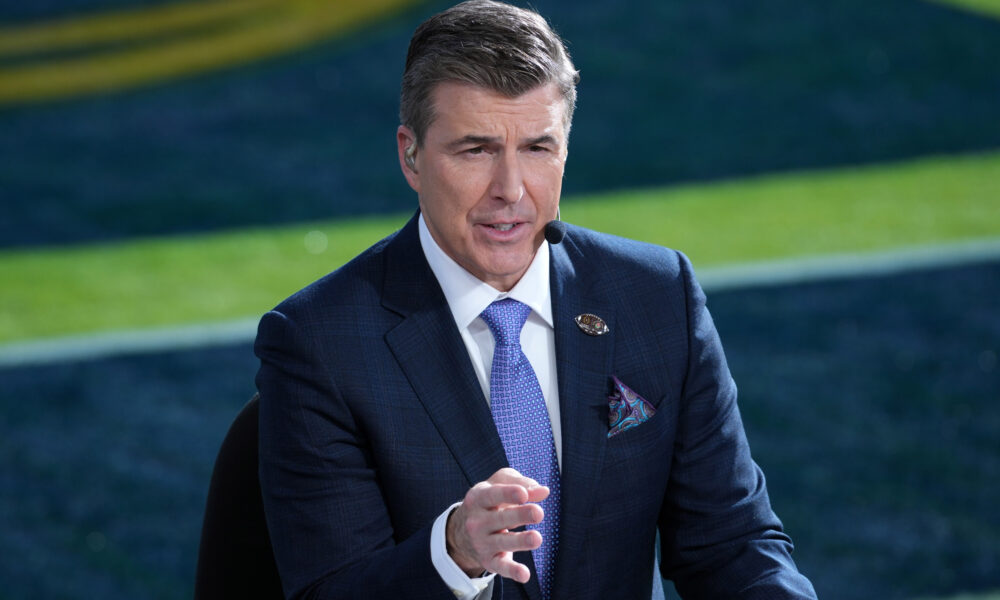
Rece Davis, the host of ESPN’s College GameDay show, recently joined The Press Box podcast and discussed the inaugural year of the 12-team College Football Playoff.
Davis weighed in on what worked and what didn’t work in year one of the 12-team format. As far as the latter is concerned, Davis believes the seeding should “be fixed immediately,” and he doesn’t think automatic byes should be awarded to the top four conference champions.
Of course, under the current 12-team format, the four highest-ranked conference champions are seeded one through four and each receive a first-round bye.
This season, those byes were earned by top-seeded Oregon (Big 10 champion), No. 2 Georgia (SEC champ), No. 3 Boise State (Mountain West champ) and No. 4 Arizona State (Big 12 champ).
“The thing that, in my judgment, didn’t work and needs to be fixed immediately is just seed the bracket. Just seed it,” Davis said. “I mean, your reward for winning your conference is getting in the field. And I thought it didn’t work having Arizona State, Boise State – deserving teams to make it into the field – did not need to get byes.
“And if it’s four Big 10 teams who get the byes, well it’s four Big 10 teams who get the byes. It’s just the way it is. As long as we’re going to do it this way with using the committee to rank the teams, then just seed the field the way they rank them and move along, and I think that gives you a better situation.”
Davis added that there was a “pretty vast difference” this season between certain conferences, like the Big 10/SEC and others, and that gap is something he wants the College Football Playoff committee to consider moving forward when it comes to the automatic first-round byes.
“People talk about strength of schedule and how you’re going to measure that, and all those things are reasonable discussions. But it’s pretty obvious that there are a couple of conferences and a few teams that aren’t like the other ones,” Davis said.
“And doesn’t mean they can’t lose, it doesn’t mean that Arizona State couldn’t have or shouldn’t have beaten Texas. But we’re talking about seeding the field based on how you’ve looked, what you’ve done up to that point. And I think the better way to do it is to whoever has done the best – nobody gets an easy path – but they get a more advantageous path rather than being put at any type of disadvantage.”
Davis made his case about the seeding during ESPN’s CFP selection show in December.
Was that him lobbying the committee to change things next season in regard to that?
“I think that when you’ve done something as long as some of us have, that doesn’t mean they have to (listen),” Davis said. “But it’s like, ‘Hey, I’ve evaluated this, I’ve made a judgment on it.’ Whether you agree with that judgment is up to you and the powers that be.”
Davis was asked how much influence he thinks his voice has, as far as impacting what the committee might do.
“I hope they respect me enough to think about it,” Davis said. “I’m under no illusion that it carries any real influence, and that goes for anybody else on our set. …
“This whole idea that me or one of the analysts can influence who might get in – I wouldn’t look at it that way when I’m talking about who I like better. But something like this that’s procedural and sort of an overarching view of the playoff I think is something where you say, ‘I think this is wrong.’ I’ve said this to the committee members, ‘I think this is wrong and I think you guys should change this.’ Whether they do or not, it’s not going to be because I said it. I just hope it gives them something to think about and they evaluate it.”