CLEMSON — It’s Super Bowl Sunday, so what better time to tell the story of how Clemson is a part of the greatest play called in Super Bowl history.
It started in 2012 when Chad Morris, who has since returned as Clemson’s offensive coordinator, and high school coach Hunter Spivey struck up a conversation at a coaches’ football clinic in Greenville, S.C.
“We were talking and somehow two-point plays came up,” Spivey recalled in a 2018 interview with The Clemson Insider. “I told him that I got one that I had ran five or six times, and I said, ‘It has worked every time.’”
The play Spivey is talking about is called “Detroit.”
Detroit?
I am sure you do not remember any famous play called “Detroit,” right?
Probably not.
You know the play, though. You just do not realize it was first called “Detroit.”
Why is it called “Detroit?”
Spivey gave it the name “Detroit” because the D in “Detroit” stands for direct snap, and the ball is directly snapped to the running back when the play begins.
Spivey first used the play back in 2011, and like it has for everyone since, it worked to perfection. Hearing how successful the play can be, Morris was intrigued to learn more about it.
However, telling someone about the play and showing them are two different things. So, Spivey did what any good football coach would do with no whiteboard around…he grabbed a napkin.
“Without drawing it up, you know how football coaches are, you will forget it,” Spivey said laughing. “You have to draw it up. You have to get it on the board. Well, there was no board around so what better thing to do, then to draw it up on a napkin.
“So, I drew it up on a napkin and we talked about it and Chad said, ‘Man, I like that one.’”
So, Spivey gave Morris the napkin and the two spoke about it for a little while longer.
Spivey did not hear from Morris for a couple of weeks, but then as Clemson was about to begin fall camp, Morris called Spivey to talk about the play a little more.
“He asked me to coach him up on it,” Spivey said. “My wife, Amy, will never forget it because she was sitting there listening to me. I was on the phone for like 20 minutes trying to coach him up on the timing of it and how you do it and how you set it up and all of that kind of stuff.
“That was kind of it. We hung up. I was expecting him to run it in the Auburn game, the first game of the season that year, but he never ran it.”
But Morris did install it into the Tigers’ playbook as one of their two-point plays. He introduced it to his offense in fall camp.
“Basically, it is a play that is kind of a one-shot deal,” former Clemson co-offensive coordinator Jeff Scott said back in 2018 with TCI. “You knew you could run it about once a year at the most. So, it was something that ever since we put it in, we practiced it every week and really just kind of held it for the right moment, whether it was in a big game, to win a game or a big two-point play. It was something that we practiced for a long time before we ever chose to run it for the first time.”
When Clemson started practicing the play, the offense first started running it without a defense and later progressed to using it against the scout team.
“I don’t think we ever ran it against our defense in a scrimmage situation or anything like that,” Scott said chuckling when thinking about trying to practice the play against Brent Venables’ defense. “I think just the timing of the whole play … Tajh (Boyd) did a really good job of getting comfortable of where he was moving and just the cadence and the snap count, there are a lot of different variables that have to go on. Everything has to work out at the same time for the play to be able to work.”
The first couple of times Clemson ran the play in practice it did not go quite as smoothly as the coaches wanted it to, but it was something over time they got very comfortable with and had a lot of confidence they could execute it when that moment came.
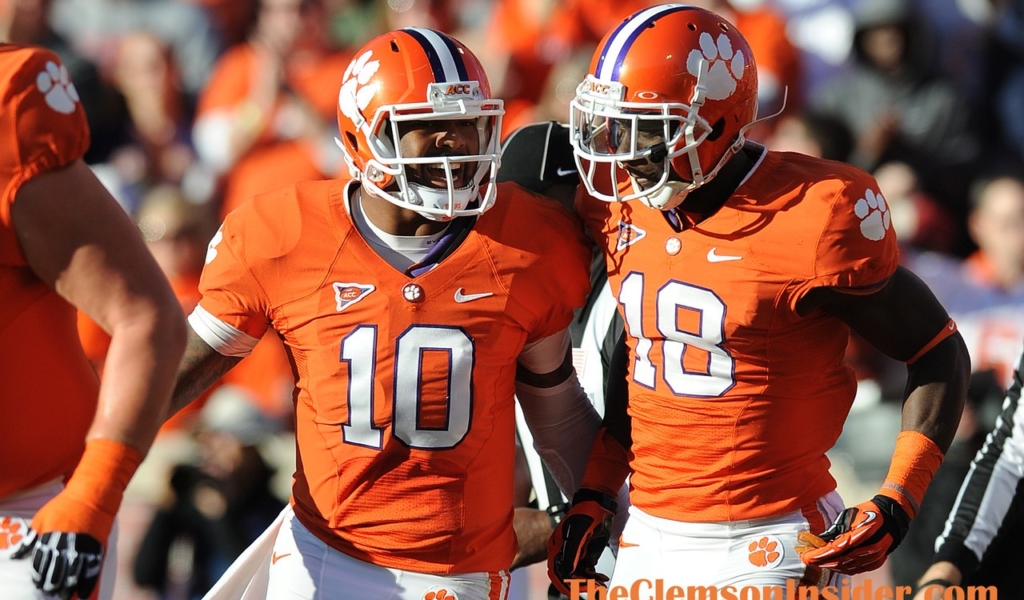
That moment came at home against Georgia Tech in 2012. Following a touchdown that gave the Tigers a 5-point lead with 10:29 to play, Morris called in “Detroit” as the Tigers tried to take a seven-point lead in the fourth quarter.
At the time, Spivey was attending the South Carolina-Georgia game. However, Spivey did not go into the stadium because he wanted to watch the Clemson game instead.
He was watching the game at a tailgate right beside where he and some friends were tailgating.
“I remember after Clemson scored, and I saw what the score was, I said, ‘Amy, he might go for two here. Come here! Come here and watch this with me.’ As soon as they lined up in the formation, I’m like, ‘he is going to run the play’ and sure enough he ran it and of course Tajh (Boyd) was wide open, and they scored,” Spivey recalled.
Since Clemson ran the play in 2012, it has been copied over and over again in college football and in the NFL.
The Chicago Bears called it the “Clemson Special.” The New England Patriots ran it in 2015 against the Philadelphia Eagles and called the play “Clemson” and then of course the Eagles returned the favor in Super Bowl LII for a pivotal touchdown just before halftime.
Right when quarterback Nick Foles walked towards the offensive line and started checking off a crucial fourth-and-goal play from the New England one-yard line, Spivey knew what was about to happen.
Foles and the Eagles executed the play perfectly and scored a touchdown that changed the momentum of the game and helped Philadelphia win its first Super Bowl title. In an interview three days later, then Eagles head coach Doug Pederson revealed the name of the play call – “The Philly Special.”
“My phone blew up,” Spivey said. “I got a lot of text messages from friends and coaches who know the story or who I have shared the play with and they were all congratulating me.”
It was a proud moment for Spivey, who first designed the play when he was at Gray Collegiate Academy in West Columbia, S.C. He was also happy for Clemson because he knows that is where the play became popular and where most people recognize it from.
“It all started on a napkin, man,” Spivey said. “There have been some great plays drawn up on a napkin.”
Including the greatest play call in Super Bowl history.