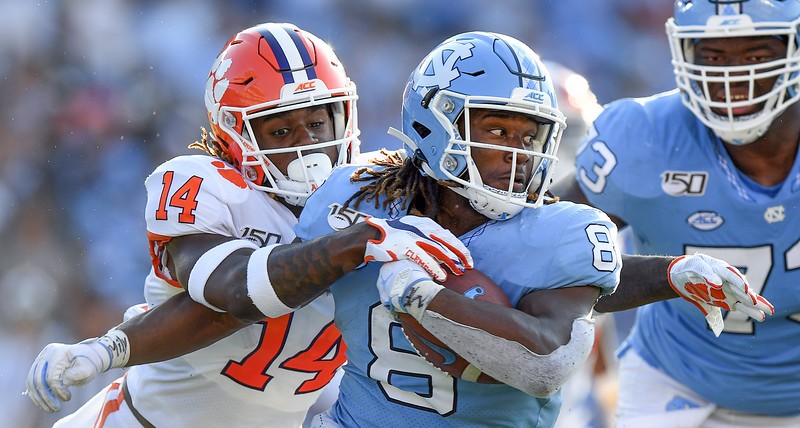
CLEMSON – There may be only one person in the world that can break down the intricacies of a Brent Venables-led defense and identify the “chirps” and “caws” of every South Carolina songbird in the same breath.
While the words “Clemson football” and “Falcons” might bring to mind A.J. Terrell or Grady Jarrett – two former Tiger players who went on to play for Atlanta’s NFL team – Denzel Johnson has a much deeper, and far more literal, connection with winged creatures.
Johnson, a former Clemson defensive back and two-time national champion, is now a licensed falconer, one of fewer than 100 in the state of South Carolina.
“What I do is falconry, and what that is is hunting with a trained bird of prey, and catching game with it as well,” Johnson told The Clemson Insider at Nalley Brown Nature Park in Easley, one of his favorite spots to go “birding.”
Falconry, Johnson explained, includes a process of trapping a large raptor, or bird of prey, training it with commands and cues, and working with it to hunt small animals like squirrels and rabbits. In some cases, he added, speaking above a Carolina Wren’s hum, raptors can even hunt deer.
Once the bird, usually a red-tailed hawk, spots its desired prey, Johnson taps into his defensive back instincts – racing through the forest to ensure the animal does not escape, and meeting his flying teammate to claim the prize.
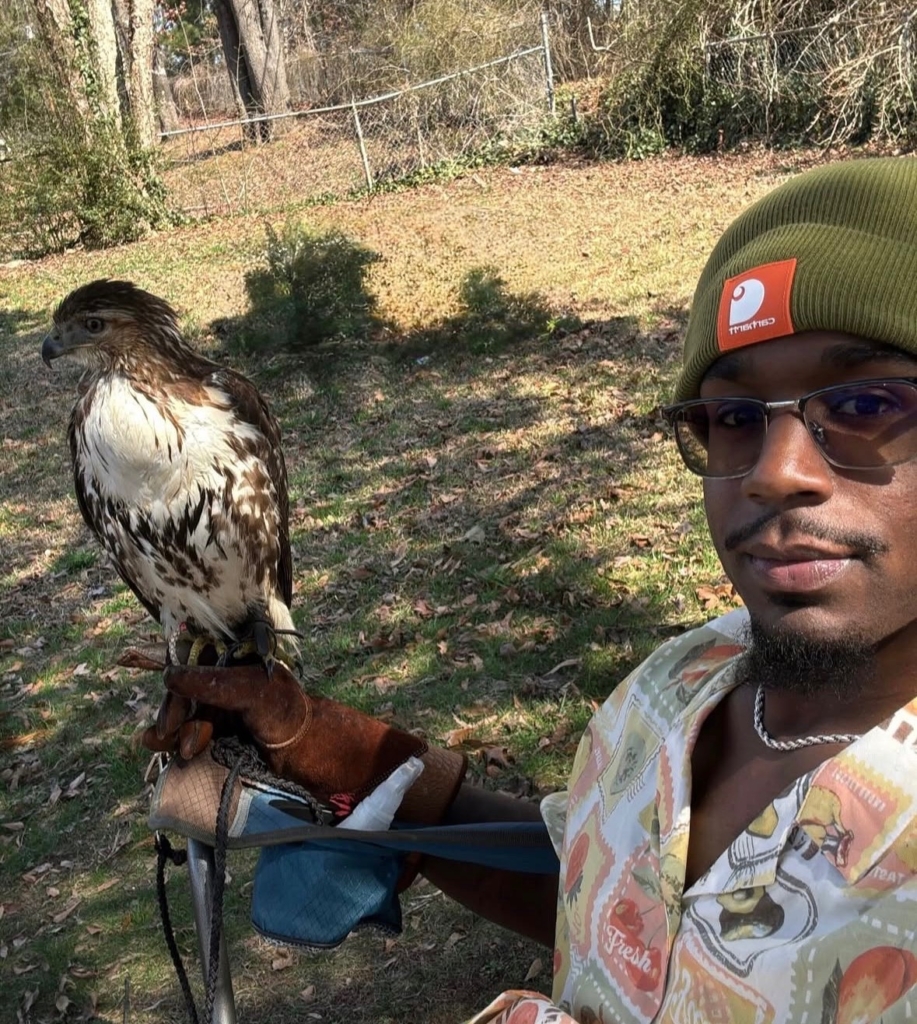
“Us falconers, what we do is we get the squirrel to move,” Johnson said, gesturing to chest and a T-shirt that reads “Nature, Nurture.” “If the squirrel moves at all then the red-tailed hawk is going to see it and it should be over.”
“I’m like sprinting through the forest trying to make sure that the squirrel doesn’t escape, giving my bird the opportunity to catch it. Not that it needs all of my assistance,” he added with a laugh.
So, how does a Power Four football player become one of fewer than 10,000 falconers in the nation? For Johnson, it all started with a prayer – and a Youtube video.
“Probably two years ago, I prayed to God about getting close to Him through nature, because I feel like I needed more, instead of just reading Bible verses and things like that,” he said. “I felt like I needed more, and nature was always there next to me.”
Whether in the form of crystal-blue lakes, or sage, mossy forests, nature has always had a calming effect on Johnson. The Columbia, S.C., native grew up fishing after school, admittedly preferring time on the water over time spent trudging through multiplication tables and algebra.
When he arrived at Clemson on a football scholarship after being named the South Carolina Player of the Year in the 3A classification, Johnson got to continue his love for fishing on Lake Hartwell.
“It’s honestly great, because you got all the lakes, you got all the land here,” he said. “There’s so much land here, and I hunt all the time, so it’s literally like a slam dunk.”
Six months after his nature-centric prayer, and a decade after he finished his high school career for the A.C. Flora Falcons, a video appeared on Johnson’s YouTube algorithm.
“I’m on YouTube, and I’m looking at kayak catfishing videos,” he said. “And there’s a video that pops up next… this guy has a golden eagle on his arm.”
“It said falconer, and my mind just started spinning, basically,” he added. “I watched the video, he’s hunting deer. And as soon as I saw that, I dove in deep. I started reading books. I started looking at stuff online. I started talking to people that were falconers. I started saying, ‘How can I become one, or what does it take?’”
After “thousands of hours” of research, Johnson took the next step. He found a mentor, began an apprenticeship – the first step in a five-year process towards mastery – and found his first bird, Draven.
From there, he committed himself fully to the craft, spending three hours a day in local parks looking for the perfect opportunity, or “split” to catch an unassuming squirrel.
“You got to spend at least three hours, at a minimum a day, at least in my world, with it,” he said. “You have to be organized and all these things, and make sure that you got the time to even do it. But, yeah, I love it.”
At first glance, hunting with a bird that has a spotted coat and a four-foot wingspan looks nothing like playing in front of 80,000 fans at Memorial Stadium in Clemson. There are no chants or cheers in the deep South Carolina forests. There are no touchdown celebrations, no concession stands with salty pretzels and spicy sodas.
But there are schemes, and curated attacks, known as “slips,” involved in falconry – not totally dissimilar to the methodology of studying a wide receiver’s weaknesses or watching a quarterback’s eyes give away his next pass.
After playing football for over a decade, Johnson is familiar with “slip” on the football field.
“I had the opportunity to be on (former Clemson) Coach Venables’ defense, which, in my world, I think he’s the best defensive coordinator ever,” he said. “All of the stuff he did was so intricate, but he made it simple to us.”
“With that, when I come out here in the slip, I look at it as a play, right? So, I know from what I learned as a falconer, I know if my bird is up in this tree,” he continued, gesturing up, “and there’s a squirrel there, I know I need to get on the other side of the tree. It’s all these game plans and stuff that I’m doing in my head.”
When Johnson gets in a stance, eyes upward, ready to take off in a sprint under the thick drapery of oak and pine to meet his flying teammate in a “game of inches,” two words echo in his head – “kickoff team.”
And with the burst, the drive, and the heavy breathing that ensues, Johnson feels an orange-tinted surge of competitive energy – the same he felt running down the hill in Death Valley almost a decade ago.
Sure, there is no Tiger Rag blasting from the southwest corner of the woods, no gathering at the Paw after a kill is made, or national championship confetti showered from the heavens, but falconry brings camaraderie, a common goal, and a chance to, again, be an elite athlete.
Additionally, Johnson said he and his birds get bragging rights if they catch more squirrels than other South Carolina falconers at the end of a six-month season.
When he is not hunting, Johnson spends time with his wife, Aliute, who is getting her Ph.D. from Clemson in Animal Veterinary Sciences. For the couple, a love for animals and Clemson football runs deeper than any of their favorite South Carolina forests.