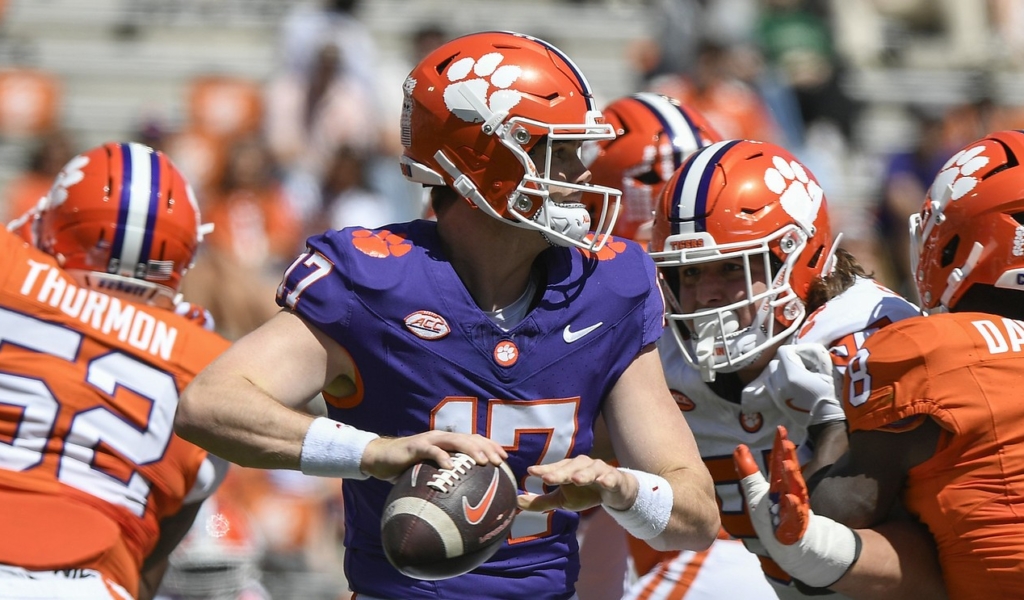
CLEMSON – It is crazy how college football is slowly turning into the NFL.
What do I mean?
Well, if you watched last week’s NFL Draft you should have noticed a pattern. A pattern you saw during the transfer portal days this past January.
Let’s be honest, the transfer portal is not the NFL Draft, it is more like free agency, but college teams are now using it to fill needs on their rosters.
If you paid attention in the last few years, especially to teams that have contended for or won the national championship, you will notice a certain pattern with those teams.
Schools that are competing at the highest level are no longer developing their own players at the most important positions. Have you seen what Miami has done the last three years? Did you pay attention to Indiana this past season?
How about Ohio State or even Notre Dame, who lost to the Buckeyes in the national championship game in 2024.
At the most important positions, like quarterback, teams in contention are using the portal to get high level players, athletes other schools have developed, to get them over the top.
Will Howard played at Kansas State for four years before transferring to Ohio State and leading the Buckeyes to a national championship. Fernando Mendoza played three seasons at California before winning the Heisman Trophy and leading Indiana to its first football national championship this past season.
Riley Leonard was giving Clemson headaches at Duke in 2023 before going to Notre Dame and leading the Irish to the national championship game in 2024. The last two years, Maimi went and got Cam Ward in 2024 and then last year stole Carson Beck from Georgia, who led the Hurricanes to the national championship game.
This year, Miami went and literally stole Duke quarterback Darian Mensah at the last minute from the Blue Devils.
Teams have also used the portal to fill needs at defensive end, offensive tackle, wide receiver and corner. Why those positions?
Think about it. Football is a passing-game now. All the rules are geared to helping the offense. So, more points can be scored, which in turn creates more interest, which helps television ratings.
Do not get me wrong. Schools are still recruiting high school kids, but if a team knows they are a quarterback or a defensive end from competing for the College Football Playoff and a possible national championship, they use the portal to fill those needs.
The first goal is to get a quarterback. Teams that have a quarterback, likely want a defensive end to rush the quarterback or an offensive tackle to protect him. If you have a quarterback that can take you to the promise land, you need a playmaking wide receiver that can make a difference. And that’s why other teams might need to tall and physical corner to matchup with the playmaking receivers.
In last week’s draft, seven offensive tackles were selected in the first round, including Clemson’s Blake Miller at No. 17 by the Detroit Lions. Five edge rushers were taken in the opening round, while five were wide receivers or tight ends, including Oregon’s Kenyon Sadiq. There were four defensive backs selected, as well.
My point is this – college football is slowly getting away from developing players and is gearing itself for the coming season instead. It is the win-at-all-cost-mentality.
The NFL does it through free agency and later the draft. College football still does high school recruiting, but not like it used to. It is all about the portal now, where you can buy a championship team in one season.
In most cases it has worked, in some it has not. However, those that do it the right way have found a system that works and it has them competing at a high level.
Clemson was hoping it was in the minority last year and it could still build a championship team primarily through high school recruiting and development. It was proven wrong, as the program had its worse year in 15 seasons despite returning most of its starters from a CFP team.
This year, Clemson went out and filled some needs on the defensive side of the ball through the portal, where it seemed to make a difference. However, Dabo Swinney chose a different path on offense.
Instead of getting a veteran quarterback out of the portal that could get his team back to the playoffs or an veteran offensive tackle or center that could protect his quarterback, Swinney chose development, again.
Could he be right? Sure, he can. Could he be wrong? We know that answer.
However, what we do know is this – if you want to win in this college football world, you must play the game and you have to start treating it like an NFL team.
Unfortunately, that is what the college game has come to.