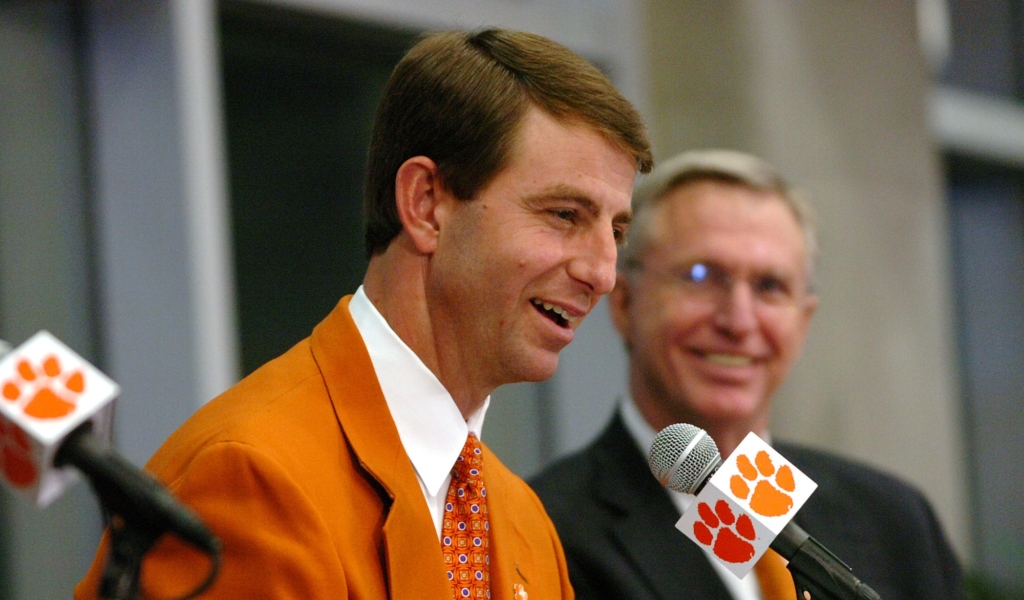
CLEMSON — Dabo Swinney quit as Clemson’s head coach.
When did it happen?
It happened two days into his tenure.
Are you confused yet?
Obviously, things worked out in the end, but there was a day when Swinney told the Clemson administration to “Take this job and shove it.”
Swinney shared this never-before story in public for the first time on Tuesday, as he reminisced about former Clemson athletic director Terry Don Phillips, who passed away Tuesday morning from an extend illness. Phillips was 78.
Phillips played an integral role in Swinney becoming and, ultimately, staying on as Clemson’s head coach after Tommy Bowden resigned from the position midway through the 2008 season. Phillips named Swinney the interim head coach–a guy he had watched for five years as Bowden’s wide receivers coach–because he knew this was the only way he would get a fair shake at the job.
Days before the alleged incident that led to Swinney quitting, he accepted the permanent position as head coach after the Tigers beat rival South Carolina in the regular-season finale. The board of trustees met, they approved Swinney’s hire and there was a press conference.
Everything was golden. Until it wasn’t.
“That was probably the biggest battle,” Swinney said. “Honestly, I am probably not the head coach here if it did not happen. We probably would not have made it. We would not have been successful. I can tell you that.”
Swinney said, at that time, there were still some walls up at Clemson that were challenges. The situation was a blessing for him because he had been at Clemson for five and a half years. He was not walking into the situation blind.
“I had an understanding of what some of the problems were and what needed to change, if we were going to have a chance. So, I kind of laid all of that out and everything was good on Sunday,” he said. “But a couple of days later, it was, ‘We are not going to be able to do that, and we are not going to be able to do that and maybe next year.’ So, I am over there like (shaking my head).
“It was a come-to-Jesus-moment. It did not go well, and it was kind of a big blow up. I packed my office up. I hadn’t even hardly unpacked my office.”
Swinney packed up what he had unpacked and called his wife, Kathleen, and told her what was going on. He told her he wasn’t worried about getting a job because he knew he could get one anywhere, though they had three young boys.
However, under the conditions Clemson’s administration set forth, he knew if they stayed at Clemson, they were not going to make it.
Ninety minutes later, while Swinney was still packing up his office, Phillips stepped into the office.
“He starts yelling at me. He said, ‘Sit down! Come over here and sit down!’ That was the maddest I had ever seen him,” Swinney recalls. “So, I sat down.”
Phillips also brought Katie Hill and Bill D’Andrea with him. Hill was in charge of the finances for the Clemson Athletic Department, at the time, and D’Andrea was Phillips’ right-hand man and his senior associate athletic director.
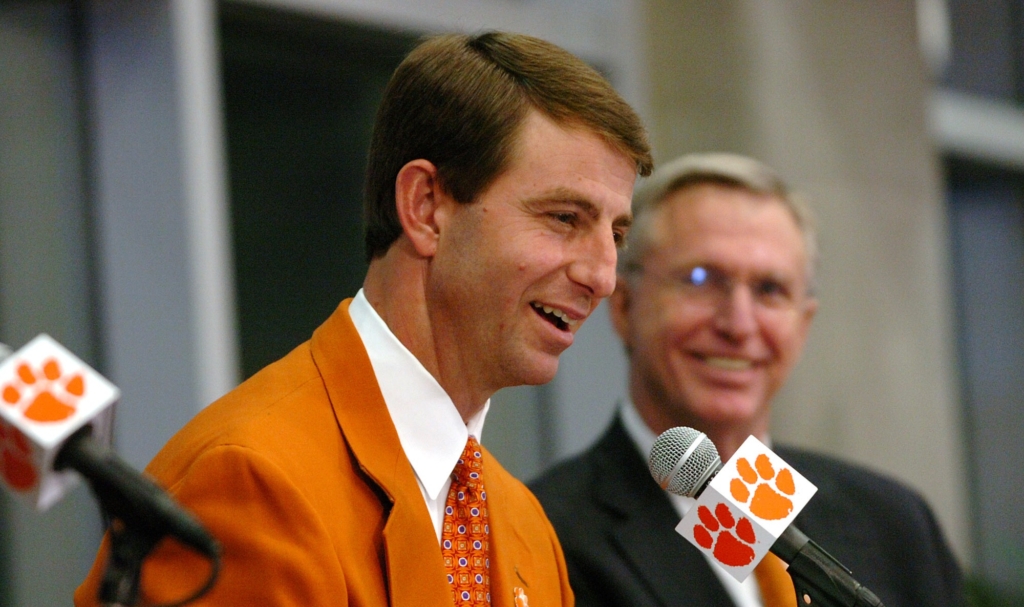
Hill was taking notes, while D’Andrea was the “peacekeeper” in the meeting.
“I knew we were not going to be successful if we were just going to keep doing things the same way,” Swinney said.
Woody McGorvey was in a car on his way to Clemson from Starkville, Miss., where he had left to become Swinney’s Chief of Staff.
“He was coming for a job that we were supposed to have that we did not have. There were a lot of moving parts going on,” Swinney said. “I remember him telling me to ‘Sit down! What do you have to have to stay?’
“I said, well, ‘I need a job for Woody McGorvey because he is going to be here at four o’clock today. He thinks he has a job, and he just told Coach (Steve) Spurrier (no).’ Coach Spurrier tried to hire him the day before to come to South Carolina. I got Woody coming and ‘I need him to have this job. I need this Chief of Staff job.’”
In those days, the staff for football programs were not like they are today. There were nine on field coaches, two graduate assistant coaches, one operations guy, a recruiting assistant and two secretaries.
Today, Clemson has more than 90 staffers working inside the football program.
“That was your whole staff,” Swinney said. “In the meantime, things had kind of changed (in college football). We did not have the infrastructure that we needed.”
Swinney told them what they needed. They called an emergency board meeting and by four o’clock that day, everything we needed was done.
“That was a tough day,” Swinney said.
Later that same night, Phillips came to Swinney’s office sat down and said, “This is why you are going to be a great head coach.”
“You fight for what you believe in,” Phillips said, as Swinney relayed the conversation. “I am glad we were able to get this worked out.”
And that is how the Dabo Swinney era began at Clemson. It was not on the football field, it was in his office fighting for what he believed in, and in the end, like he always did, Terry Don Phillips had his back.
“What a man’s man,” Swinney said.