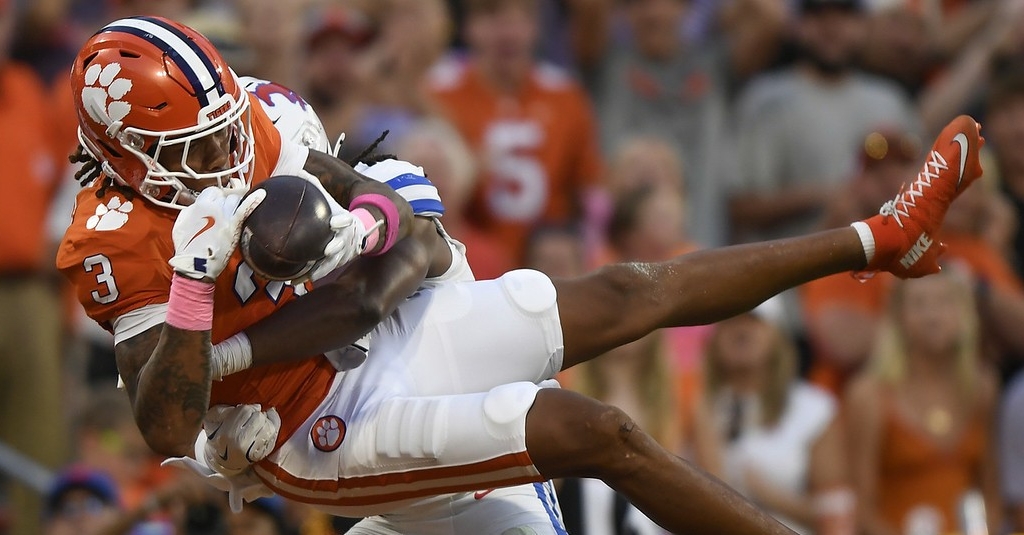
CLEMSON — I understand NCAA President Charlie Baker did not have a good week.
First there was the Brendan Sorsby injunction, allowing the Texas Tech quarterback to become eligible despite the fact he admitted to gambling on college football and his own team. On Friday, Clemson wide receiver Tristan Smith was granted a temporary injunction, allowing him to become eligible for the 2026 football season, as well.
And though I understand Baker’s feelings surrounding the Sorsby injunction, I do not get his beef with Smith.
On Saturday, Baker tried to say Smith’s eligibility ruling was a result of what happened in the Sorsby vs. NCAA complaint, taking to X and using a snippet of South Carolina’s 13th Circuit Judge Jessica Salvini’s order granting Smith injunction to try and make his case.
“The Sorsby decision was never about only one student-athlete. We are already seeing downhill effects in other eligibility cases in which state courts are allowing student-athletes to circumvent longstanding eligibility rules, citing Sorsby outcome as part of the court’s precedent,” Baker wrote in his post along with the snippet of the Smith order. “Another example of why we need Congress to pass the Protect College Sports Act, authorizing the association to apply common sense eligibility rules consistently for all student-athletes and schools, regardless of the state or local court system.”
Baker is wrong in trying to use the Smith ruling to make his point. He claims Judge Salvini used the outcome of the Sorsby case as precedent for her ruling on Smith, and that was not the case.
The Court actually used the NCAA’s own ruling in the eligibility waivers granted to Malik Benson and Diego Pavia.
“The NCAA granted the eligibility waiver for both individuals. Mr. Benson’s case is nearly identical to the present case. Mr. Benson also attended Hutchinson Community College, and like Mr. Smith, had two JUCO years counted by the NCAA. Nevertheless, the NCAA granted Mr. Benson the waiver and he was permitted to compete for the University of Oregon. The only material distinction the Court can identify between Mr. Benson’s case, and the instant matter is that Mr. Smith’s final Division I season falls in 2025-26 rather than 2024-25,” according to the order granting Smith the temporary injunction.
Smith’s co-counsel, Darren Heitner, who also represented Benson, explained why the Court cited Sorsby in its order.
“The Court merely cited Sorsby v. NCAA to identify the types of irreparable harm that exist when the NCAA renders an athlete ineligible. As the Court noted, I also represented Malik Benson. Had Benson not received an extra year to play at Oregon, [he] may have not been selected by an NFL team. That’s why it’s irreparable harm; it cannot be remedied by monetary damages,” Heitner wrote on X.
“State courts are not ‘allowing student-athletes to circumvent longstanding eligibility rules.’ They are holding the NCAA accountable to its own rules, which the NCAA has and continues to arbitrarily enforce. The solution is simple. Stop selectively enforcing rules. The NCAA gave JUCO players in Diego Pavia’s graduating class an extra year of eligibility. It needs to do the same for all former JUCO players. Otherwise, it’s an arbitrary exception for one class of athletes without any foundation whatsoever.”
And more importantly, Baker needs to stop using a case like Smith’s, a kid—who has done nothing wrong and is the epitome of a student athlete—trying to play the game he loves for one more year and comparing it to a case where a player literally broke the rules and found a loop hole to avoid suffering the consequence of his actions.
They are not the same, and, in my opinion, Baker owes Smith and Judge Salvini an apology.