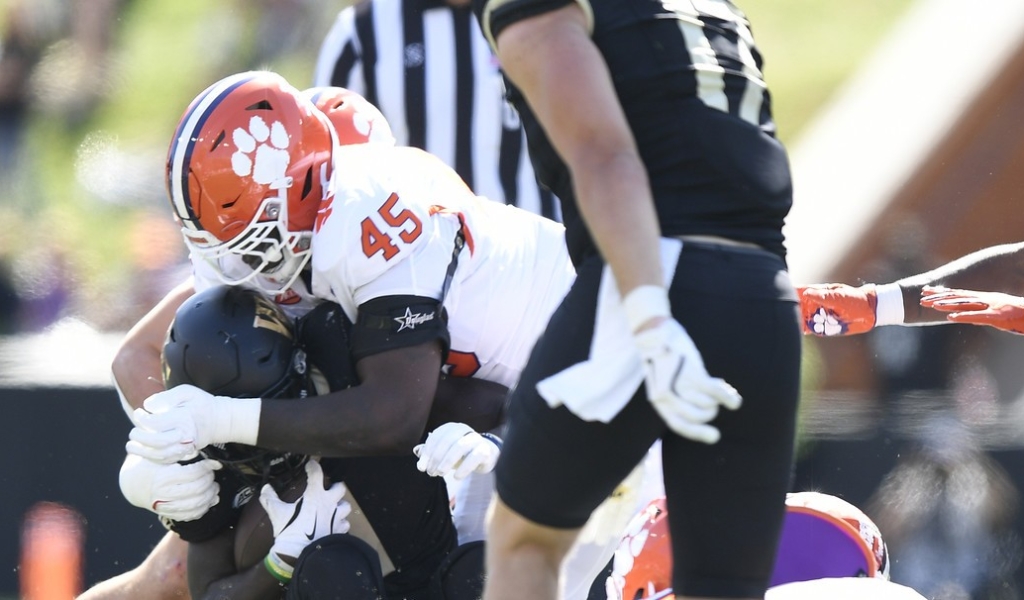
CLEMSON – Like many facets of Clemson’s 2026 football team, the Tigers’ defensive line will look a little different this year.
There will still be familiar faces, including defensive ends Jahiem Lawson and Will Heldt, but with an offseason influx of transfers and others primed to take on a bigger role, Clemson’s front line defense success will be determined by players stepping up from last year.
Entering the 2025 season, one of the big names to know on Clemson’s defense was defensive end T.J. Parker, who was coming off a season with 11 sacks and 19.5 tackles for loss, both team highs.
Though not fully adhering to preseason expectations in 2025, Parker went on to post 12.5 tackles for loss and 5.5 sacks in 2025, including a three-sack game against rival South Carolina. The second-round NFL Draft pick may have been who offenses prepared to handle on the edge, but Heldt, on the other side, ultimately stole the show.
The Carmel, Ind., native, a transfer out of Purdue, finished his first season at Clemson with a team-high 15.5 tackles for loss and 7.5 sacks. With a 6-foot-6 frame, Heldt’s length bothers offensive tackles, and allows him to create separation. Paired with a motor that never quits on a play, the edge rusher is one of the best run defenders in the country and never gives the quarterback a long, comfortable time in the pocket.
With Parker gone this year, Heldt will become the defensive end name to know in offensive scout meetings, with a preseason All-ACC Award strapped to his back. If he can increase his sack numbers while continuing to stop the run, he will be a major piece of Clemson’s ability to generate turnovers and shut down drives before they start. He will be too important to take out of any game for long, and with the nickname “The Robot,” he may not need to come out much at all.
Last year, Lawson often came in for Heldt on the left side, paired with Parker on the right. This season, however, the redshirt senior is in prime position to become an every-game starter.
Before suffering a late season-ending injury in 2025, Lawson had a breakout year. The Central, SC., native, finished third on the team with 3.5 sacks, despite not starting any game. He also racked up 6.5 tackles for loss. With added weight since he arrived on campus and a passionate love for Clemson, Lawson’s energy provided a much-needed spark at times last year.
If he can continue the explosiveness and stay consistent with increased reps and his hands, he and Heldt will make for a pair of ends that could be disastrous for offenses to handle.
The Tigers also added two edge rushers in the portal in C.J. Wesley and London Merritt. Wesley, a Howard transfer, will add depth to the defensive ends room. His first-step explosiveness will earn him snaps, especially in passing situations.
Though he is not nearly as polished as Heldt, and probably is not an every-down end, he provides an ability to get to the quarterback quickly, which would help Clemson’s sack and turnover numbers from last season.
Merritt, on the other hand, is a true athlete. At 6-foot-3, the Colorado transfer ranked as one of the best high school players in the nation for a reason. He is track-star fast, fluid, and generated 14 quarterback pressures on limited snaps last season.
Like Wesley, Merritt is not as polished as someone like Heldt and has limited in-game experience. If he improves and gets opportunities, though, he could be one of the best pickups of the portal class and could even threaten for a starting opportunity at some point. It will all come down to how he develops and how disruptive he is in given chances.
Moving to the interior, Clemson lost two major players to the NFL this offseason. Peter Woods and Demonte Capehart were both selected in the 2026 NFL Draft. In their absence, new players will need to step up — maybe more than at any other defensive position.
Clemson saw what it will lose with Capehart–freaky athleticism for his size–and Woods, who has devastating sack potential and ability to swallow up double teams. With those losses, defensive coordinator Tom Allen went into the portal and got Kourtney Kelly, Markus Strong, Andy Burburija and Devarrick Woods.
Strong, at 6-foot-3 and 295 pounds, is a disruptive presence. The Raiford, Fla., native played three seasons under former Clemson defensive coordinator Brent Venables at Oklahoma, notching 14 tackles and a sack last season. Strong played behind All-SEC starters, and wanted to have more opportunities at Clemson.
Unlike some of the other transfers, Strong will have no issue adjusting to the speed of play at the ACC level, and could immediately make a difference with his ability to hold strong and not get pushed around.
Like Strong, Kelly was also set to make an immediate impact. However, the big West Georgia transfer tore his ACL in spring practice and will be unable to participate in fall camp, but has not been ruled out for the season just yet.
Woods, a graduate transfer that Clemson picked up after the injury, will help to make up for some of that depth.
Burburija, a junior college product, should also give the Tigers’ defensive line some support, and with high success at that level, he could become a great addition once he adjusts to the speed and physicality.
Clemson’s biggest defensive line question, however, might lie with Vic Burley. The big defensive tackle was the highest rated high school player in the 2023 class, even more so than Parker and Woods.
After an injury that sidelined him for his freshman season, Burley has not made it into the regular rotation as often as the coaches would like. He did record to two starts late last season and finished the year with 15 tackles and a pass breakup.
This is Burley’s time to shine and to make a name for himself, while becoming “the guy.”
Last season, Clemson’s defense struggled to force turnovers. They finished with just 17 takeaways — the first time since 2004 the Tigers did not produce at least 20 turnovers in a season.
Prioritizing turnovers will be paramount this season, especially with a Chad Morris offense that historically turns the ball over.
How can the defensive line assist in this?
They need to provide more pressure up front and get into the backfield more frequently. In the last two seasons, Clemson has finished both years with 35 sacks.
Last year, it ranked 21st nationally. However, 17.5 of these sacks came from linebackers and defensive backs. That means that the Tigers’ defensive line was responsible for just half of the sacks, though they made up 70 percent of defensive pressures.
Since 2012, the year Brent Venables took over as DC, Clemson leads the nation in total sacks, with an average of 42.5 in each year. The best season in that regard came in 2018, when Clemson’s defense generated 54 sacks.
If players like Lawson and Burley can get their sack numbers up with more opportunities, and a few of the transfers step up to get to signal-callers quickly, the Tigers are likely to create more turnovers.
Additionally, the only forced fumble from a defensive lineman last year came singularly from Heldt, though Parker recovered three. Stripping the ball from running backs could also be a way the D-Line gets more involved.