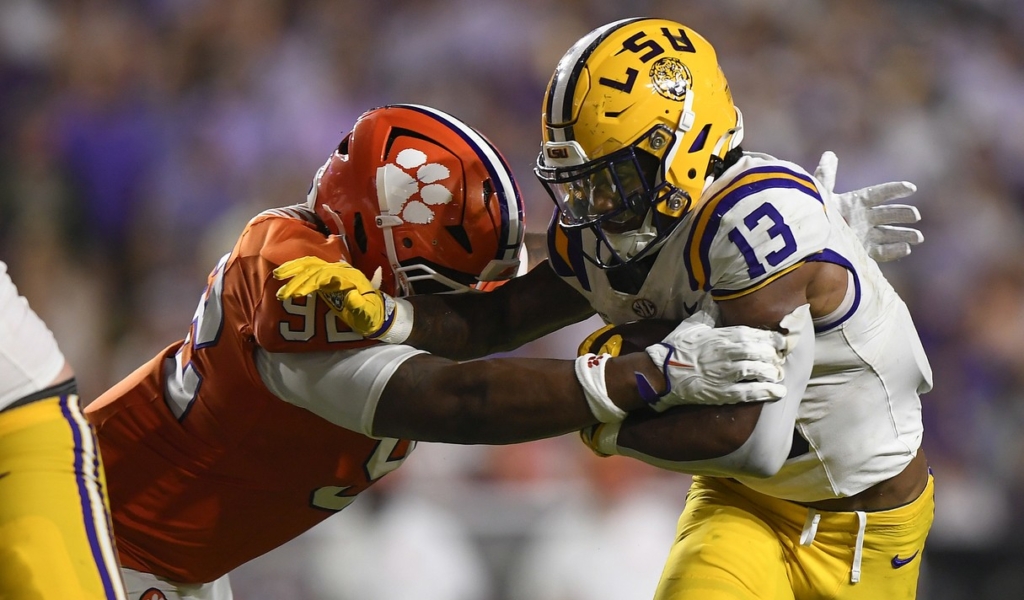
BATON ROUGE, La. – When Clemson defensive coordinator Tom Allen arrived in the Upstate of South Carolina ahead of the 2025 football season, he had a simple message.
The veteran coach wanted the Tigers to be the “best tackling team in America.”
But at Tiger Stadium in Baton Rouge, La., on Saturday night, Clemson was far from even being the best tackling team on that field.
After an early interception from defensive back Ashton Hampton on the second play of the game, the Tigers’ defense was unable to do much to contain the Bayou Bengals, surrendering several missed tackles in Clemson’s 51-10 loss to LSU at Tiger Stadium Saturday night.
“At the end of the day, you’re not going to win if you can’t stop the run,” head coach Dabo Swinney after the defeat. “And we didn’t, and in particular, got to set the edge. So, we just did a really poor job of setting the edge, you know, especially versus the stretch. And then the quarterback run was which really killed us on third down. I think they were 11 of 16 on third down. And, you know, 200 yard rushers, quarterback, one of them.”
The debacle, really, started on the second defensive possession of the game. Though LSU was contained to just a field goal by Clemson’s defense, that drive included 14 and 21-yard completions, as well as eight and nine-yard runs from Dillin Jones and quarterback Sam Leavitt, respectively.
From there, the purple-and-gold Tigers only seemed to punish Clemson’s defense more with each possession as Leavitt, an Arizona State transfer, got more comfortable with the weapons around him.
Several Clemson players were routinely out of position, and took poor angles to make tackles as LSU picked up 19 first downs in the first half. For reference, Clemson had one singular first down in the first half, and it came after Hampton’s interception in the first 90 seconds of the game.
The thing that was most concerning about Clemson’s defense– or encouraging about LSU’s offense, based on your perspective– was that the flaws were not just coming from one area. There was no single individual struggling to tackle a running back or bring down Leavitt.
Instead, the discrepancies were everywhere.
For starters, LSU averaged 6.5 yards per carry in the first half, running the ball 213 yards on 33 attempts. For context, the best ‘yards-per-carry’ team in the nation last year averaged around six yards per carry. Clemson allowed just 3.54 yards per carry last year.
It also did not help that Clemson let Leavitt have 100 rushing yards and two rushing touchdowns in the first half alone.
The rushing defense, which struggled mightily, was not the only way the Tigers’ defense got exposed, however. Though Leavitt did not throw for a touchdown in the first half, he completed nine passes for 123 yards. These passes averaged 14.4 yards to Clemson’s 7.5. Leavitt went on to throw for 230 total yards and a touchdown.
He was then replaced by LSU’s backup signal-caller for most of the fourth quarter.
“(Leavitt) made a lot of plays and obviously there was a lot of new players we didn’t know a whole lot about as far as seeing them, but I think it started with him and then their ability to run the ball,” Swinney said. “I mean, the stretch, it kept us just out of sync all night. It kept them on schedule all night long.”
On the Leavitt connections, LSU’s receivers averaged almost 6.8 yards after completion, again highlighting Clemson’s failure to tackle, not just its inability to limit Leavitt from getting off a good look.
Additionally, LSU was also four-for-four in the red zone, finishing with a touchdown any time they came close to the goal line, while, of course, Clemson never made it into LSU territory. They had only eight first downs in the whole game, and four came on the final scoring drive.
By the first defensive possession of the third quarter, Clemson head coach Dabo Swinney had had enough of the failures, and put in several players that were not even listed on the depth chart provided by LSU’s communications department.
Clemson gave up two more touchdowns in the third quarter, allowing 21 combined points in the second half.
Clemson safety Jerome Carter finished with a team-high 11 tackles, followed closely behind by Corey Myrick and linebacker Sammy Brown’s 10. It was not nearly enough to shut down LSU’s over 600 yards of total offense.
“It’s disappointing not only as a team, you know, as a man,” Brown said. “That hurts. That hurts. But if I know one thing about this team and the way that we’ve worked this off season, it’s that we’ll respond. And, and I think the leaders on this team are strong. and you know it didn’t go how we wanted tonight and I don’t think in a million years I would have thought that’s how it’s gone but I know we’ll respond.”
Clemson will need to do some soul-searching before playing Georgia Southern next week.